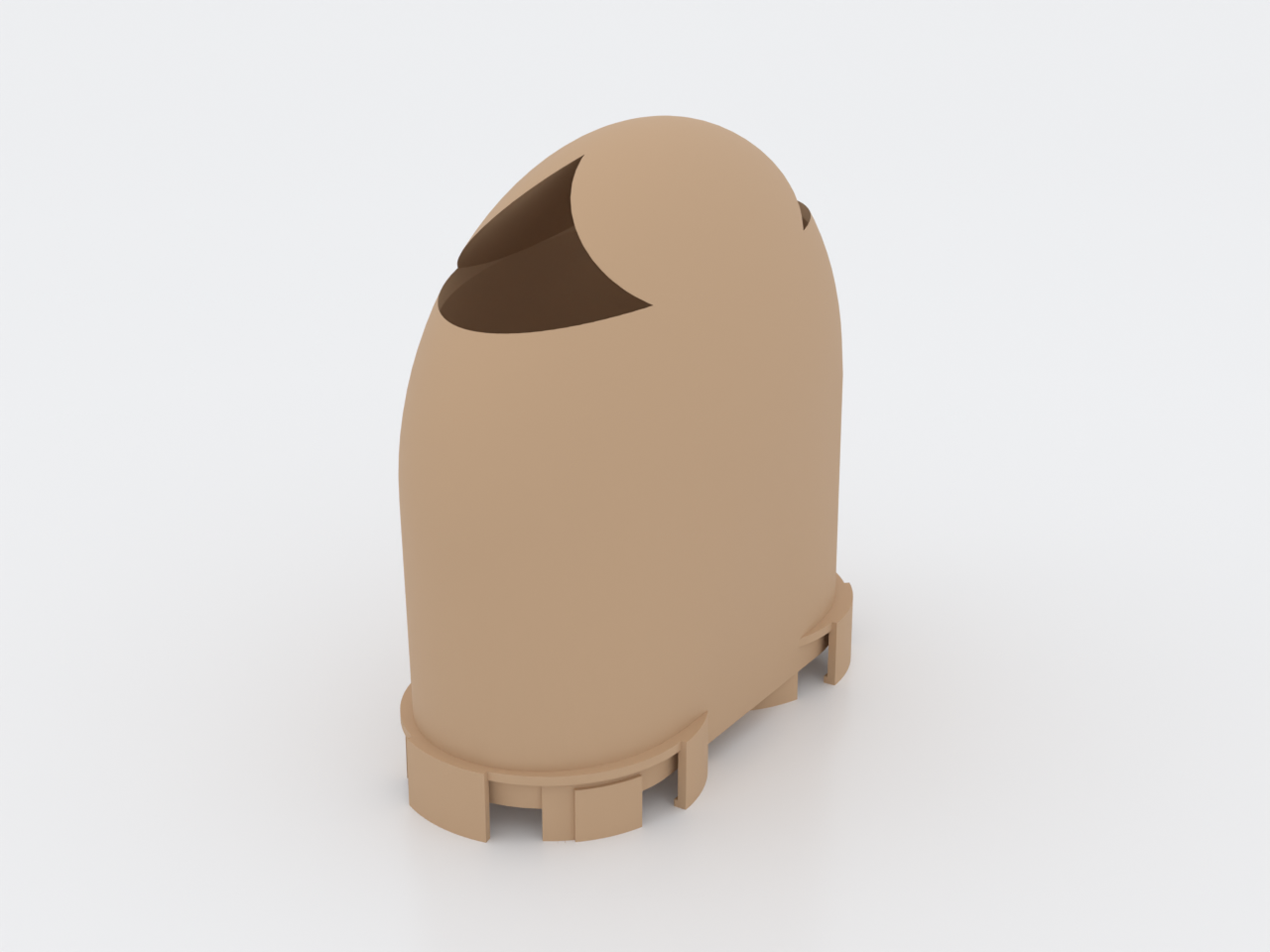
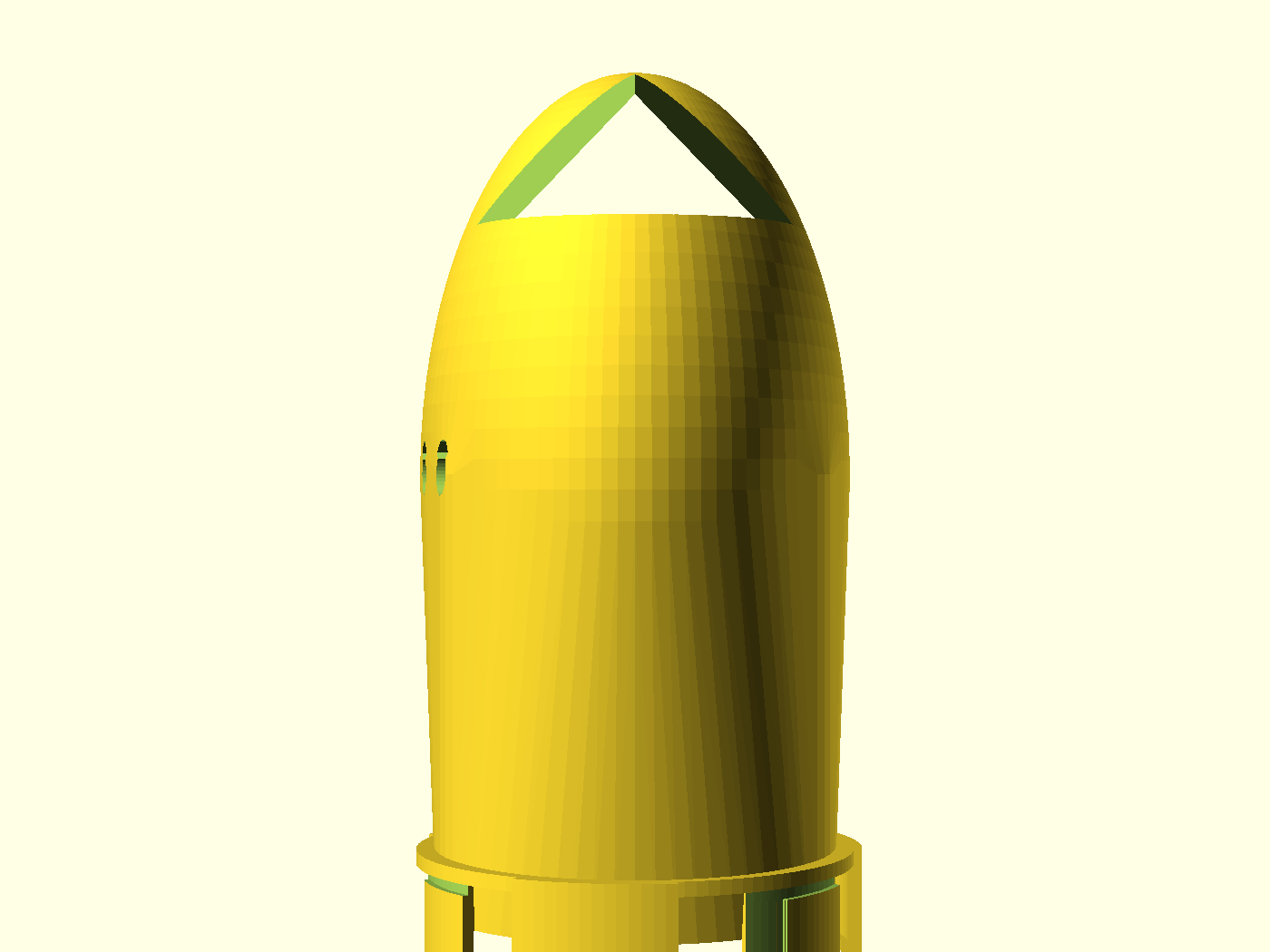
The run-resetter for the N.U.G.G.S. hamster-tunnel system: a widened chamber carrying the standard genderless quarter-turn port on two faces, so an adult Syrian can enter one port, pivot 180° on a shallow dish, and leave the other — doubling a run back on itself. This is the module that makes layouts larger than one straight tube legal: the welfare rule caps any continuously enclosed run at two body lengths between breaks, and a chamber this wide that is itself open to ventilated air is one of only three breaks.
Work in progress — nothing in this system has been printed yet. The node passes
gate.sh --slice(printcheck + a real test-slice, support-free), butport_tol = 0.30is an untested guess inherited from the shared standard. Print the coupon first (see Assembly & use) and expect to tune it.
Where a turnaround belongs
It is the counterpart of the den, and the opposite
job: the den is a dead-end refuge (too narrow to turn in, does not reset
the run count); this is a pass-through wide enough to turn in, which does.
Put it wherever a run has to double back — along a wall, or at the end of a
shelf-line (closed loops: pending the N2 source read — the family charter has
only checked the open-run rule). The two ports are parallel and 97 mm
apart, so the modules mating them leave side by side; that spacing is derived
(≥ 2 × port radius) so two mating modules never collide. The full rule and
its source live in designs/nuggs/PM.md (N2) and
docs/nuggs-research.md.
What you get
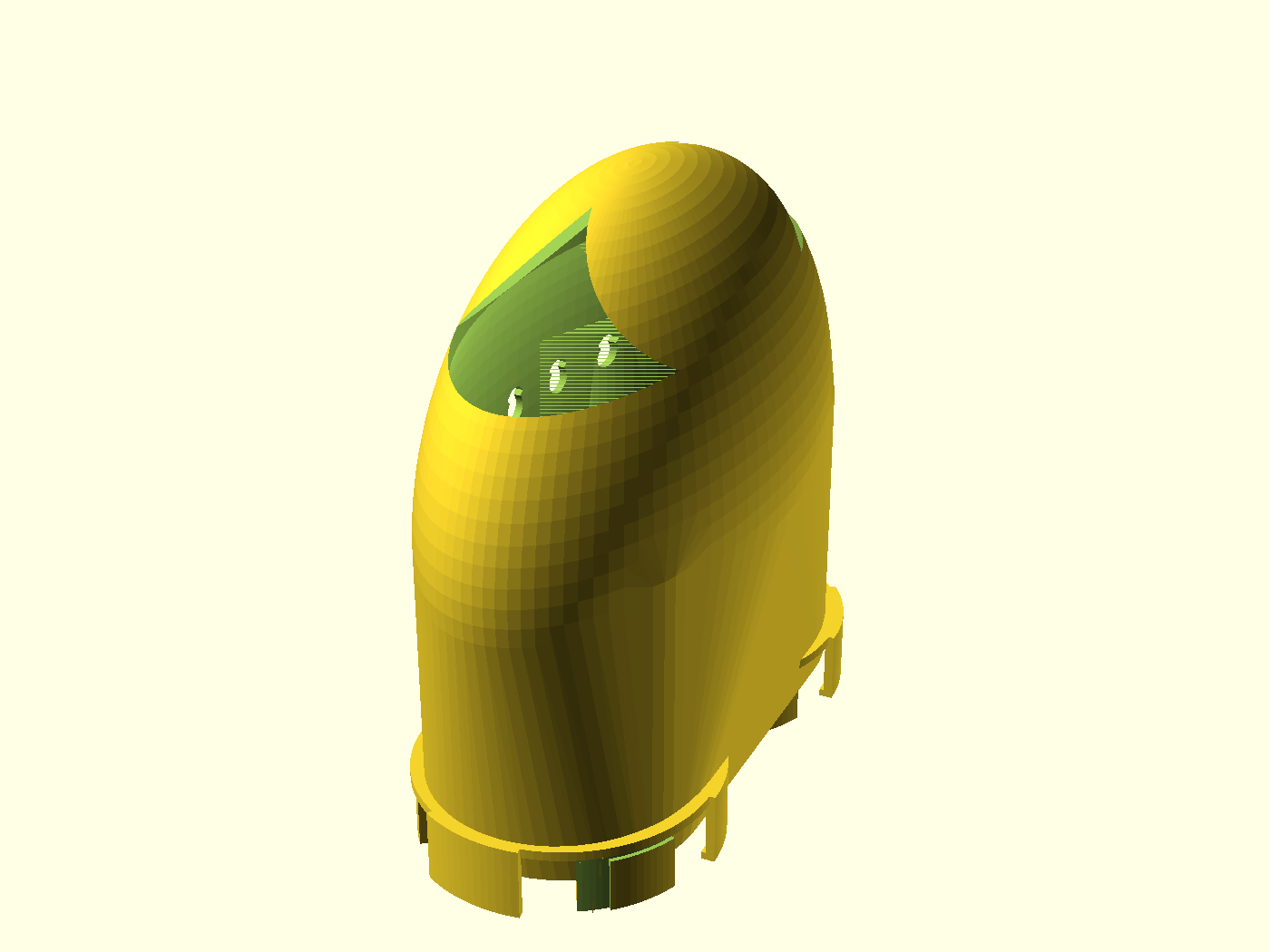
turnaround— the node (≈ 99 × 205 × 195 mm at defaults): an oblate chamber over a solid web, two Ø80 mm ports on the underside, six ceiling vents.coupon— the standard NUGGS port stub (~21 mm, ~2 h 17 m to print) for tuning the joint fit before you commit the 1 d 0 h 12 m print.
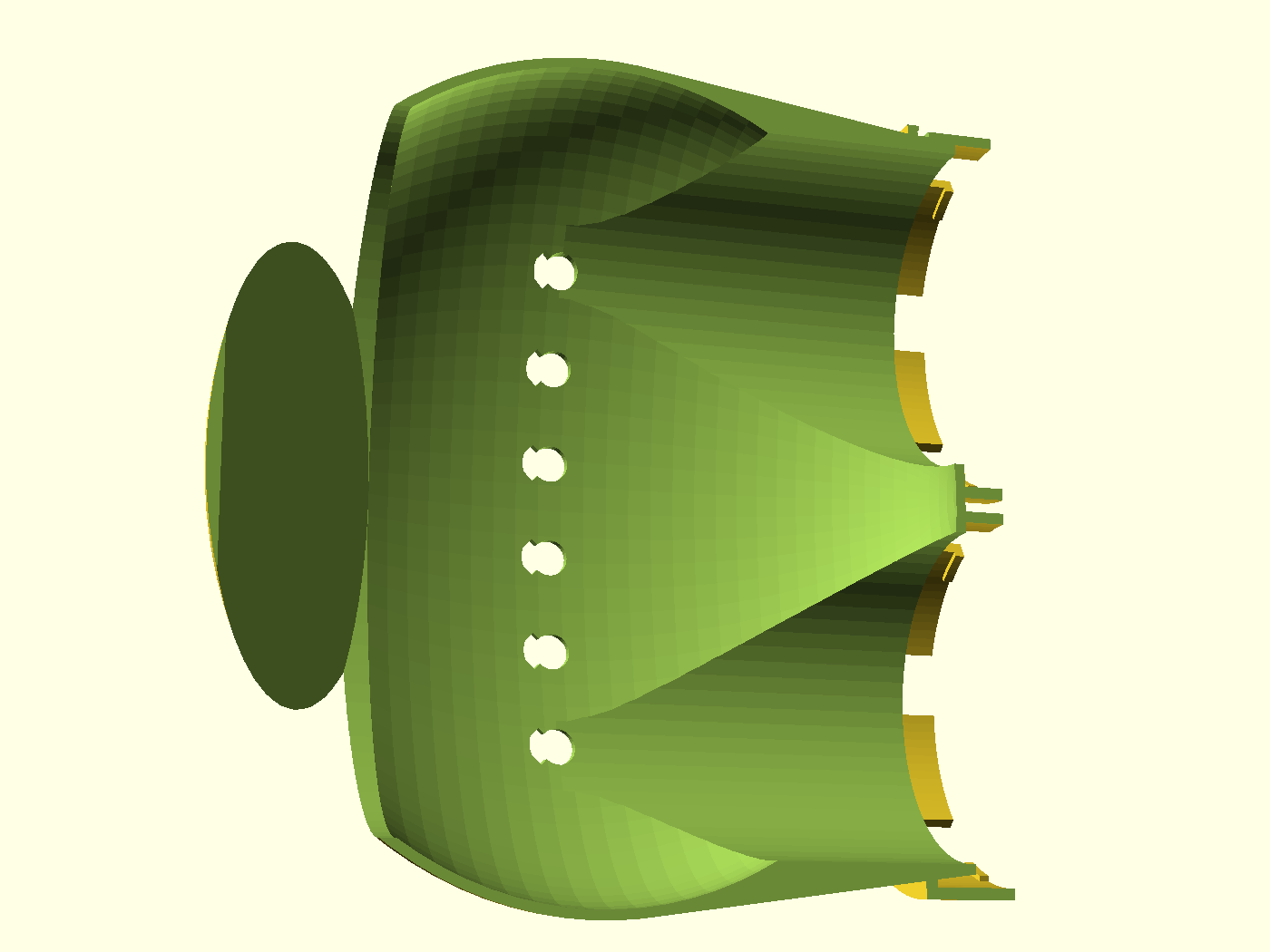
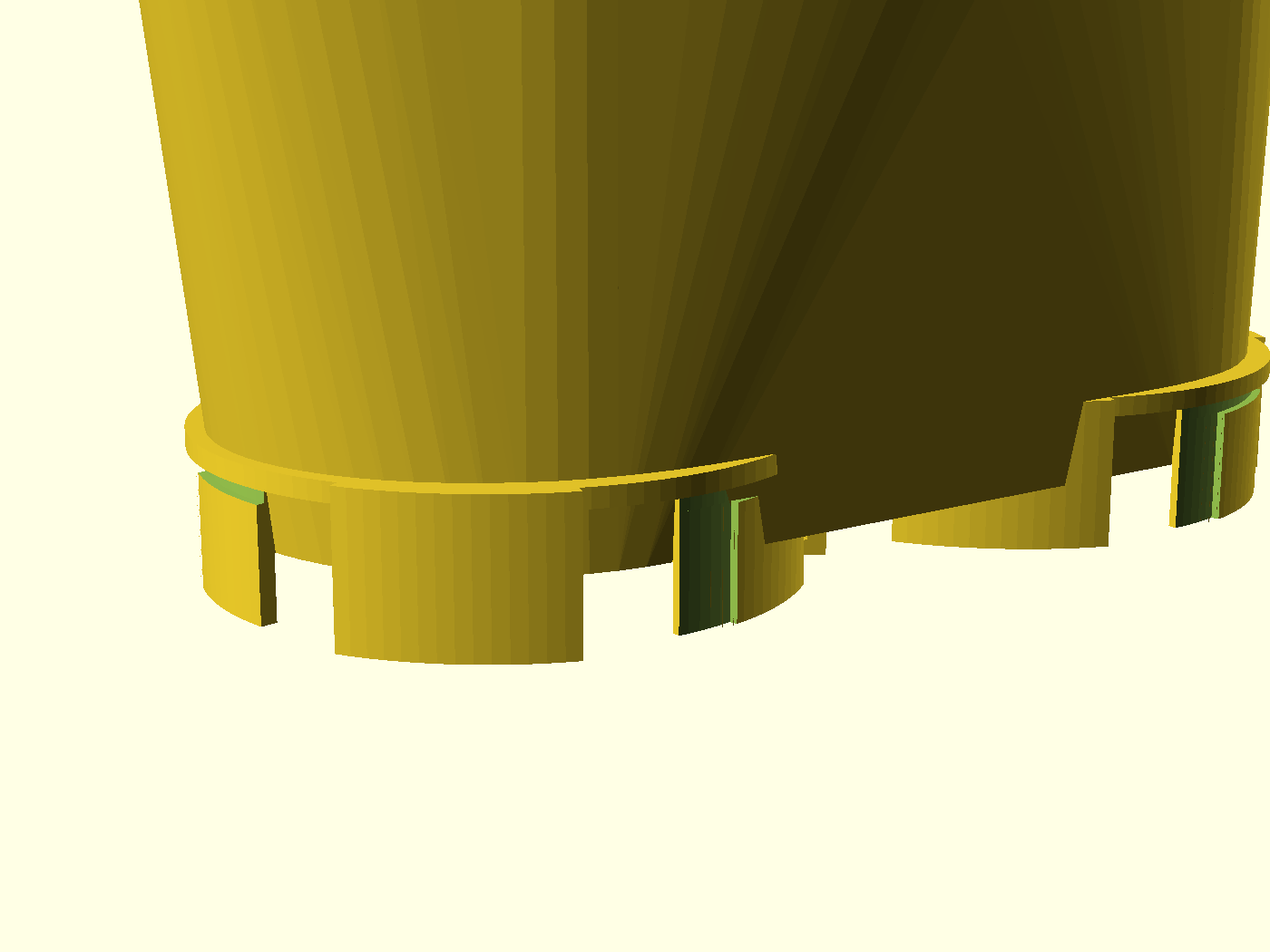
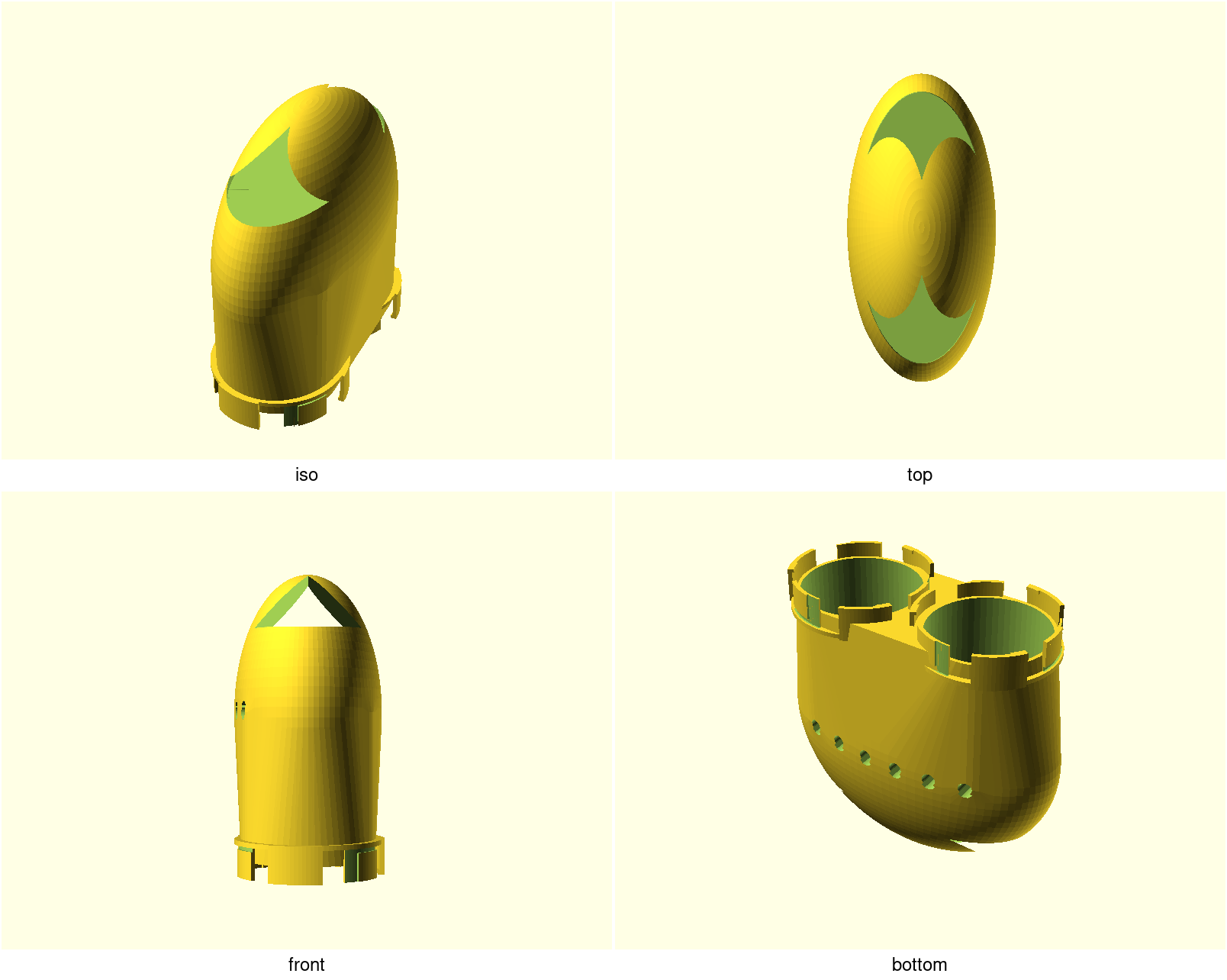
The port faces the hero can't show are in the 4-view contact sheet's
bottom-iso quadrant — the port-face view, both rings on their sector feet —
and, at first-layer resolution, in
bed-contact.png.

The three things the shape is doing
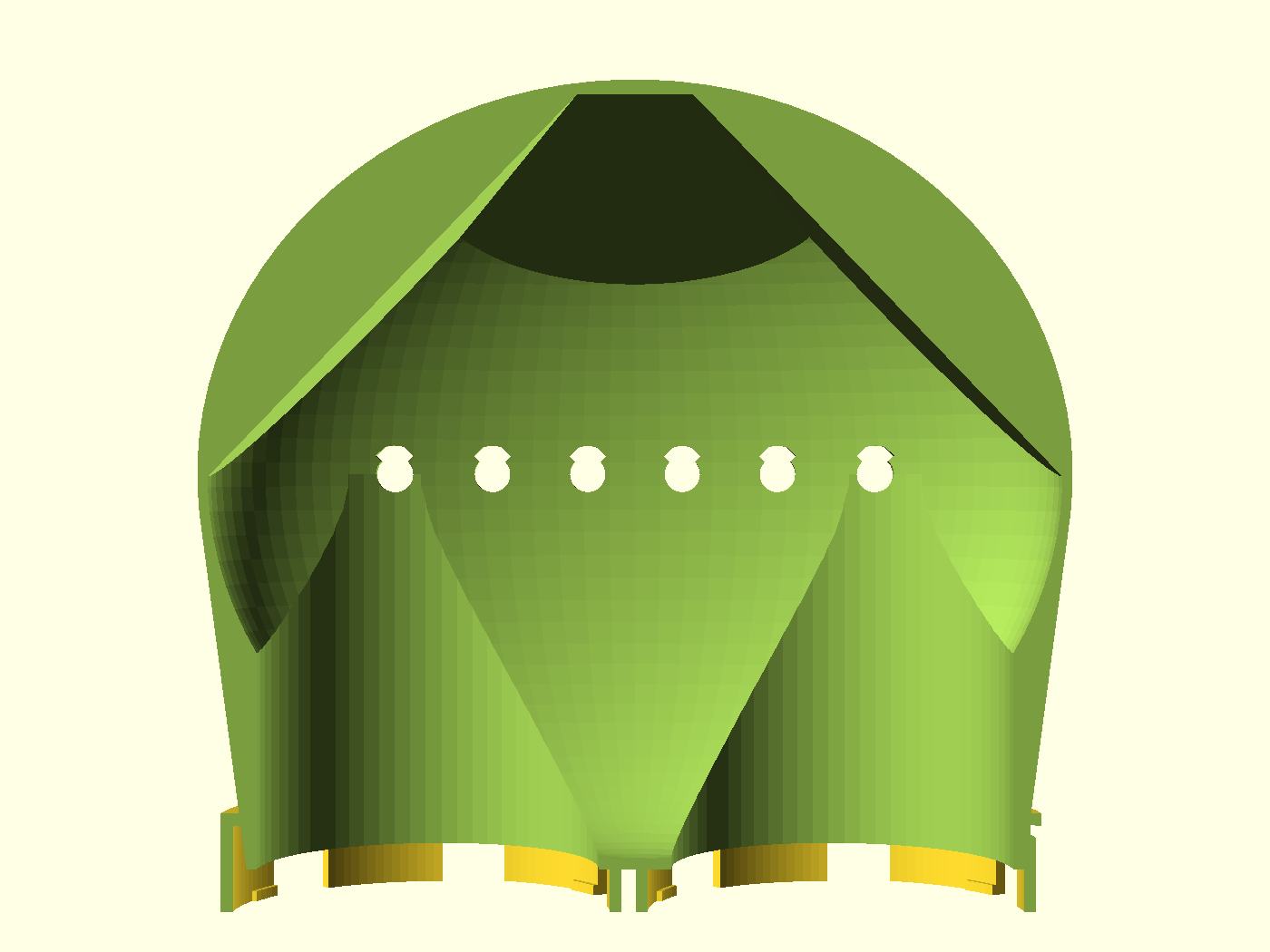
- A dish, not a floor. The chamber floor is the widened bowl's own curve, and it meets each bore mouth ~1 mm below the bore floor — the route steps down, never onto a lip. The grade across the dish peaks at 14.6°, inside the welfare ceiling of 15°, and eases to flat at the bottom of the bowl.
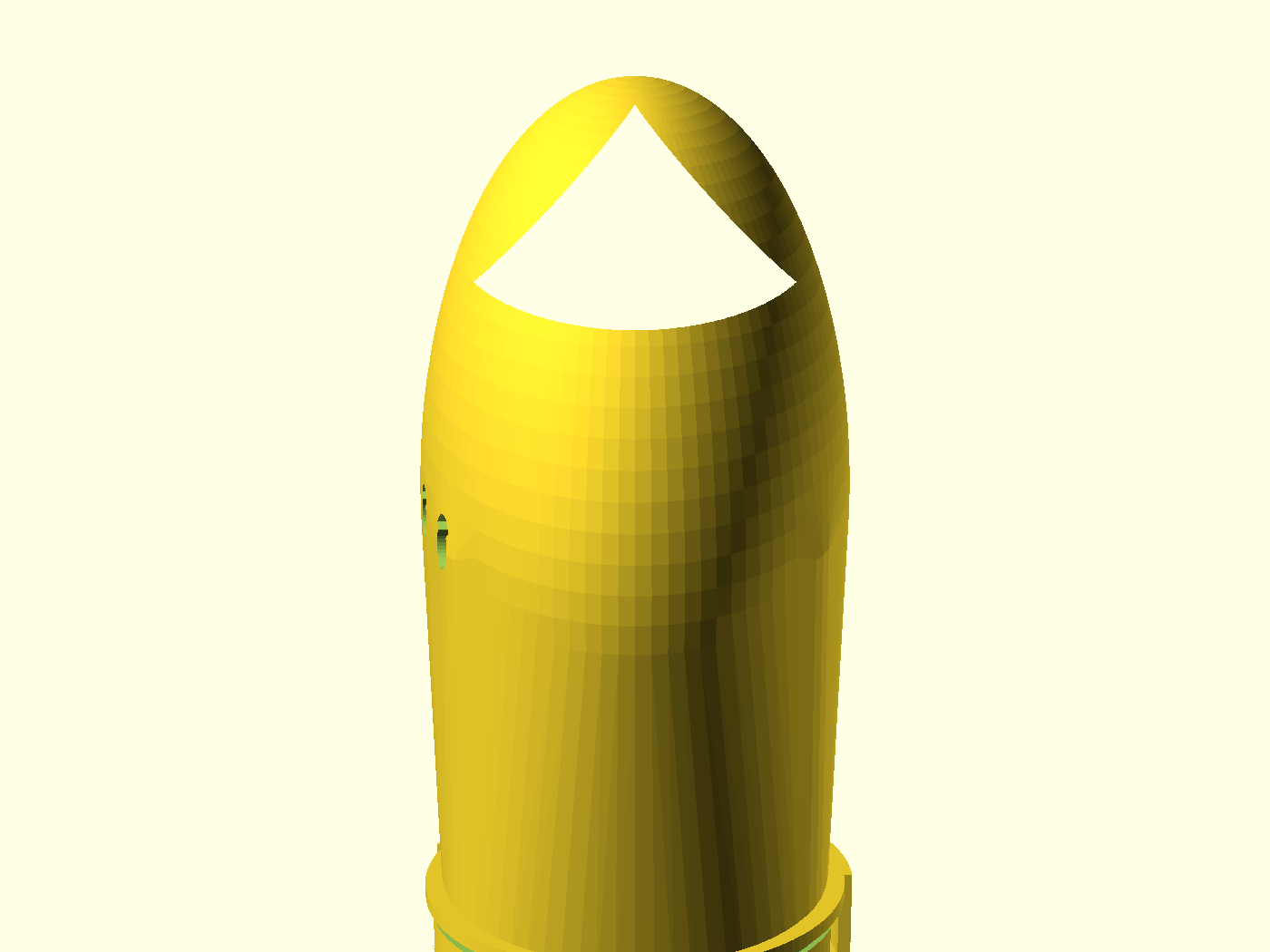
- A hipped vault, not a dome. An enclosed near-flat ceiling cannot print support-free, and a domed crown over a chamber this wide would be one. The chamber closes instead on a hipped vault — roof planes at ~46° meeting at a ridge, hipped at the same angle down into the ends. Because the ceiling is the pointwise minimum of the chamber and those planes, the cavity cannot run past the shell anywhere — closing the end windows that rule now guards against was issue #499. Every surface self-supporting by construction; that shape took the printcheck overhang figure from 9% to 2% of surface.
- Vents where the air is. Six Ø9 mm teardrop vents on the use-ceiling, the same count and size the den's chimney derivation gives, over ~2.4× the air volume with the same one-animal occupancy. Open to ventilated space is what makes the chamber a legal run break, not just a wide room; the teardrop profile prints support-free and gives a gnawing incisor no purchase.
Print settings
- Material: PLA preferred; PETG if it must live warm. Natural or uncoloured filament is a safety decision, not a colour preference: a gnawing rodent abrades pigment straight into its mouth, and the chamber ceiling is within a standing animal's reach. In PETG, know where the symptoms land before you chase them: a sagged web underside faces the bed inside a ~10 mm slot no blade reaches, and the roof prints ridged behind the Ø9 vents — accept both, slow the roof, re-check the fit after. Expect strings between the islands for the first hour — they merge away at the port plane; let it run.
- Layer height: 0.2 mm.
- Infill: 15–20 % is plenty; the shell does the work.
- Seam: Back (or scarf) — same setting for the coupon and the node; stock
Aligned stacks a ridge on the port collar that reads as
port_toltoo tight. - Supports: none needed. Ports down on their sector tips, the bore ceilings close at the coupling's proven 45° class, the web is a 12 mm anchored bridge, the belly dome is pole-flush on the bed, and the crown is the hipped vault above. The whole part is support-free as modelled. Keep auto-supports off even if your slicer offers them: anything it builds inside the chamber is unreachable through six Ø9 mm vents. The roof undersides print ridged at 46° — that's inside the chamber, by design.
- Orientation: as modelled — both ports down, sector tips on the bed, the chamber up. Do not rotate it.
- Brim: off — adhesion comes from mouse ears placed radially outside the port ring, not a brim. Only the sector tips touch the bed (the web is the bridge at the port plane, 10 mm up), so the first ~50 layers print as twelve small islands that merge at the port plane — expected, not a fault. A brim would weld across the mating feet; ears large enough to tie the islands together would have to bridge an inter-foot gap, and they snap off at the one-layer interface, leaving exactly the scar the deburr step below already prescribes. Give it a clean sheet and no draft over the bed, and watch the first hour — twelve free-standing islands is where a 1 d 0 h 12 m print dies if it's going to.
- Heads up: ~195 mm tall — check your Z. It fits the 256×256×256 class this family gates on, but it is a big print: CI's test-slice reports 1 d 0 h 12 m and 349.52 g at 0.2 mm (the coupon is ~2 h 17 m).
Parameters
The handful most worth tuning; the rest are grouped in the Customizer sections
at the top of nuggs-turnaround.scad.
| Parameter | Default | What it does |
|---|---|---|
port_tol | 0.30 mm | The one fit knob for the quarter-turn joint. Tune on the coupon in ±0.05 steps. |
bore_d | 80 mm | Internal bore — the shared NUGGS headline number. |
body_len_mm | 180 mm | The animal's body length. The clear-width assert keys on it: the chamber must stay at least this wide inside. |
chamber_ay | 100 mm | Chamber half-width along the turn axis — the cavity's widest line tracks 2× this (~200 mm at defaults; measured, because the roof's hip planes trim the ends). |
chamber_ax | 47 mm | Chamber half-width across the route — sets the dish the animal crosses and the bore-mouth handoff. |
max_incline_deg | 15° | The welfare ceiling on route grade. The dish-grade assert keys on it (14.6° at defaults). |
n_vent / vent_d | 6 / 9 mm | Ceiling vent count and diameter. |
wall | 2.4 mm | Shell thickness — about six perimeters at a stock 0.42 line width; leave wall loops at default. |
Override on the command line with, e.g., -D 'port_tol=0.35'. Every dimension
above is enforced by an assert in the .scad, so an out-of-range value
fails the render. That seals the dimensions, not the whole part — the #499
roof gap scored 84/100, watertight, with every assert green — so the gates
and the previews, not the asserts alone, are what make it shippable.
Assembly & use
- Print the coupon first (
nuggs-turnaround-coupon.scad,21 mm stub) — in the same material as the node. If this is your first NUGGS module, print the coupon twice (4 h 35 m / ~60 g for the pair). Mate two of them (or one to any NUGGS module) — it must insert to the collar face and lock with a light quarter turn: firm, no rattle, no forcing. Forcing loose → raiseport_tol+0.05; will not lock → lower 0.05. If it inserts but the quarter-turn grinds near the lock, deburr the sector tips' first layer with a blade before touchingport_tol— or set Elephant foot compensation to 0.2 mm on the coupon. Leave EFC off the node and deburr it after the print instead: EFC insets the first layer's outline, and that outline is the only adhesion twelve free-standing islands have. The coupon also previews what the first ~50 layers will look like: the same sector feet, printed as free-standing islands. - Print the node ports-down, no supports, no brim.
- Fit it between any two NUGGS faces: push together and twist a quarter turn either way — one port at a time, twisting whichever half is still free in the air (two engaged bayonets 97 mm apart on a rigid body cannot turn together). The same order is the emergency order: twist one, twist t'other.
- Place it where the run doubles back — for the shelf planner, the node in use stands 195 mm along the tube run and 205 mm across it. The animal enters, climbs the ~1 mm step down onto the dish, crosses, pivots in the 200 mm-wide bowl, and leaves the second port. Bedding will collect in the dish; that is fine — it is a pass-through, not a refuge, and the den is the module that wants the bedding — but strip the dish's bedding at the weekly clean: the vents' no-purchase argument assumes the ceiling stays a full standing reach away, and a packed mound shortens it. You don't have to wait for the weekly clean to catch one: a torch through a vent when you change the water tells you — if you can see a mound, strip it, and the drum going quiet is the same tell. Before you twist the node off for any of that cleaning, check it is empty: tap and listen, then a flashlight through two vents — sound is one-directional, and a sleeping hamster is silent in an opaque drum. Clean it hand-wash only, lukewarm (≤ 50 °C), never the dishwasher: heat deforms PLA, and a deformed tube is a narrowed tube — the material failure mode is the injury failure mode (family charter N7).
One stated trade, so it isn't an omission: the chamber is opaque, and you will never see the turn — you'll hear her cross before you see her (six open vents carry sound, and 349.52 g of hollow shell is a drum at 2 a.m., her prime time). If watching matters, transparent PETG buys you a silhouette; a windowed variant is a possible future derivative.