
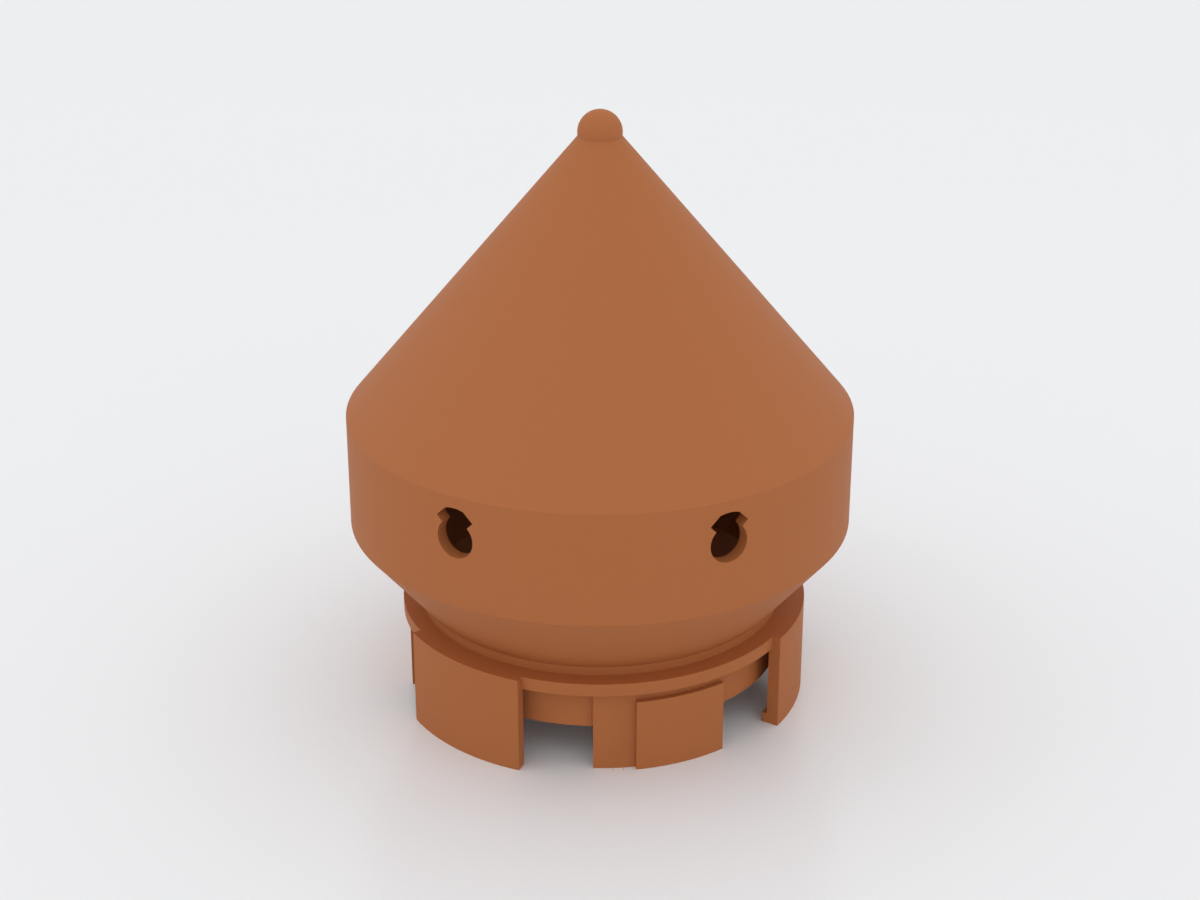
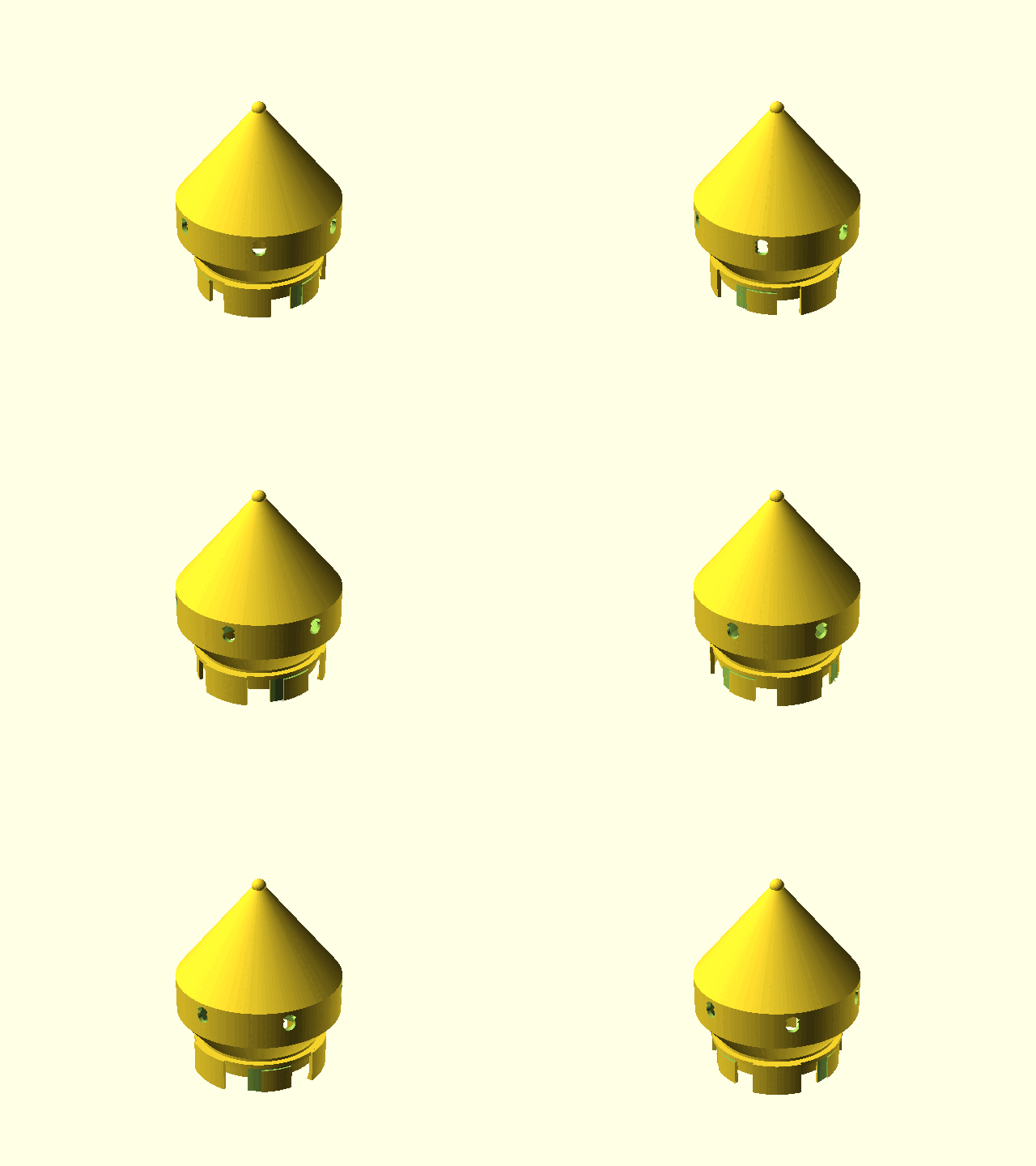
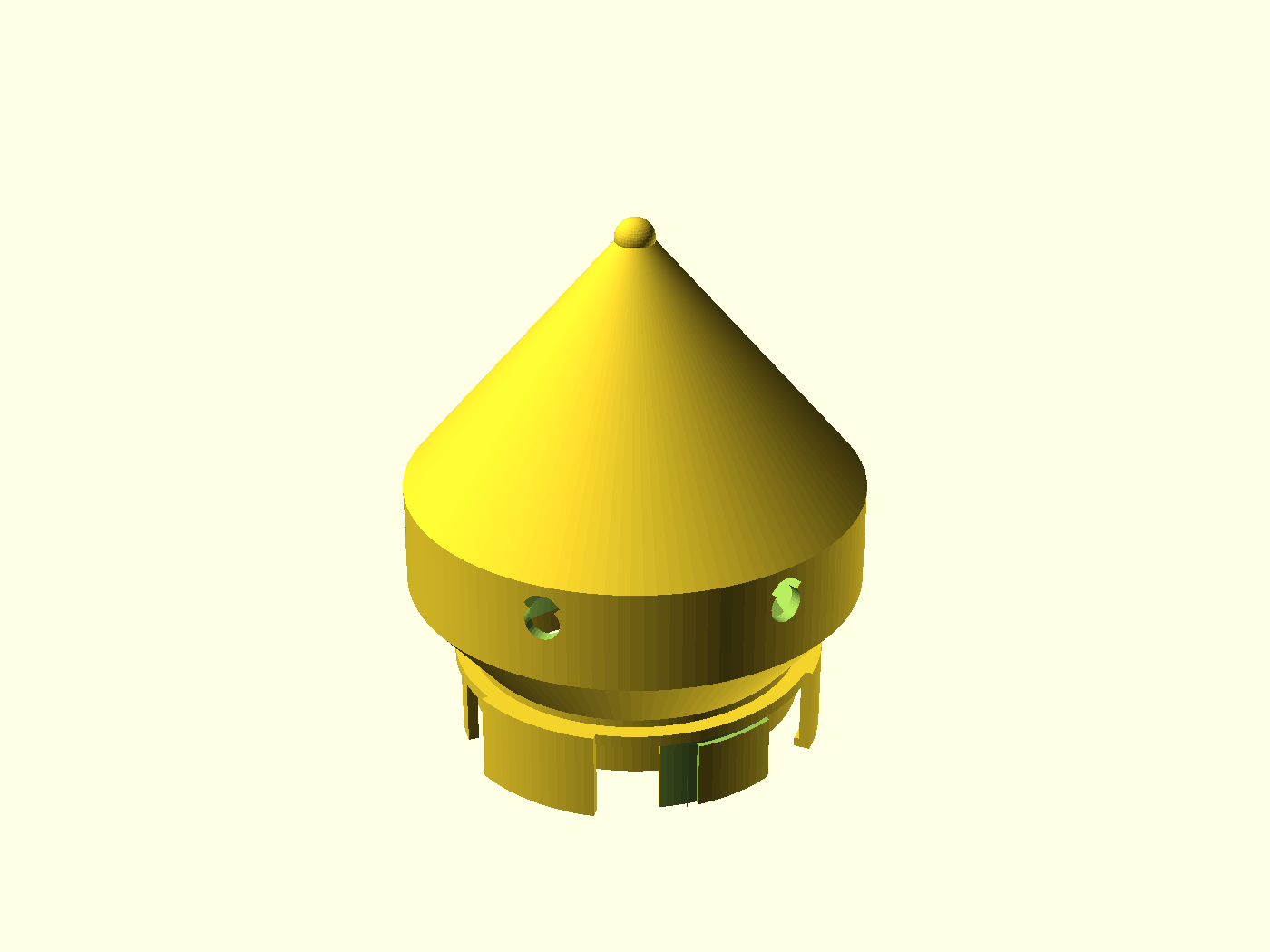
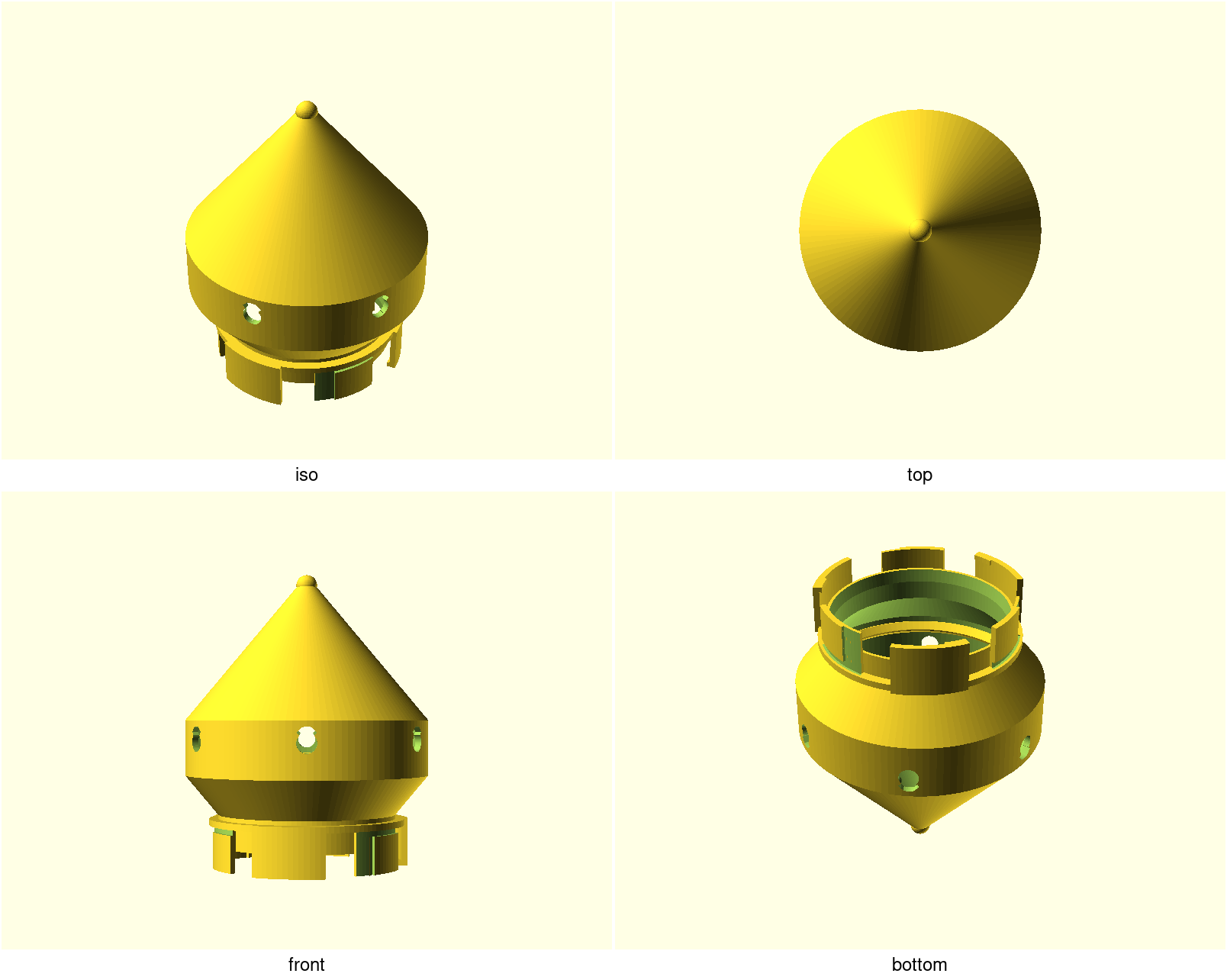
A terminal refuge for the N.U.G.G.S. hamster-tunnel system: a single-port rounded burrow bulb that caps the end of a run, so a short bridge ends in a place to hide and hoard instead of a flat wall. It carries the same genderless quarter-turn port every NUGGS module shares, so it clicks onto any face either way round. Not a tube, not an elbow — the one module you stop at.
Designed for a hamster, by (the fiction goes) a hamster. Every feature here is a piece of Syrian-hamster husbandry a person plumbing a tube kit wouldn't think to add — an opaque refuge, a flank scent-rub rail, a convective vent chimney, and a cheek-pouch-relief mouth. The reasoning for each is in
NOTES.md.
Work in progress — nothing in this system has been printed yet. The den passes
gate.sh --sliceand is watertight in geometry, butport_tol = 0.30is an untested guess inherited from the shared standard. Print the coupon first (see Assembly & use) and expect to tune it.
Read this first — where a den belongs
A den is a dead-end. Its clear internal width (110 mm at defaults) is less
than a Syrian's body length, so the animal cannot turn around in it and
must reverse out. Under the NUGGS welfare rule a den therefore does not
reset the run-length count — it is a refuge, not a turnaround. Use it to cap
a short stub, where the reverse-travel budget isn't already spent by the
tube feeding it. It buys refuge, opacity and ventilation for a run end; it does
not buy length. The full rule and its source live in
designs/nuggs/PM.md (N2) and
docs/nuggs-research.md.
What you get
One printed part: a domed refuge chamber with a NUGGS port on the underside.
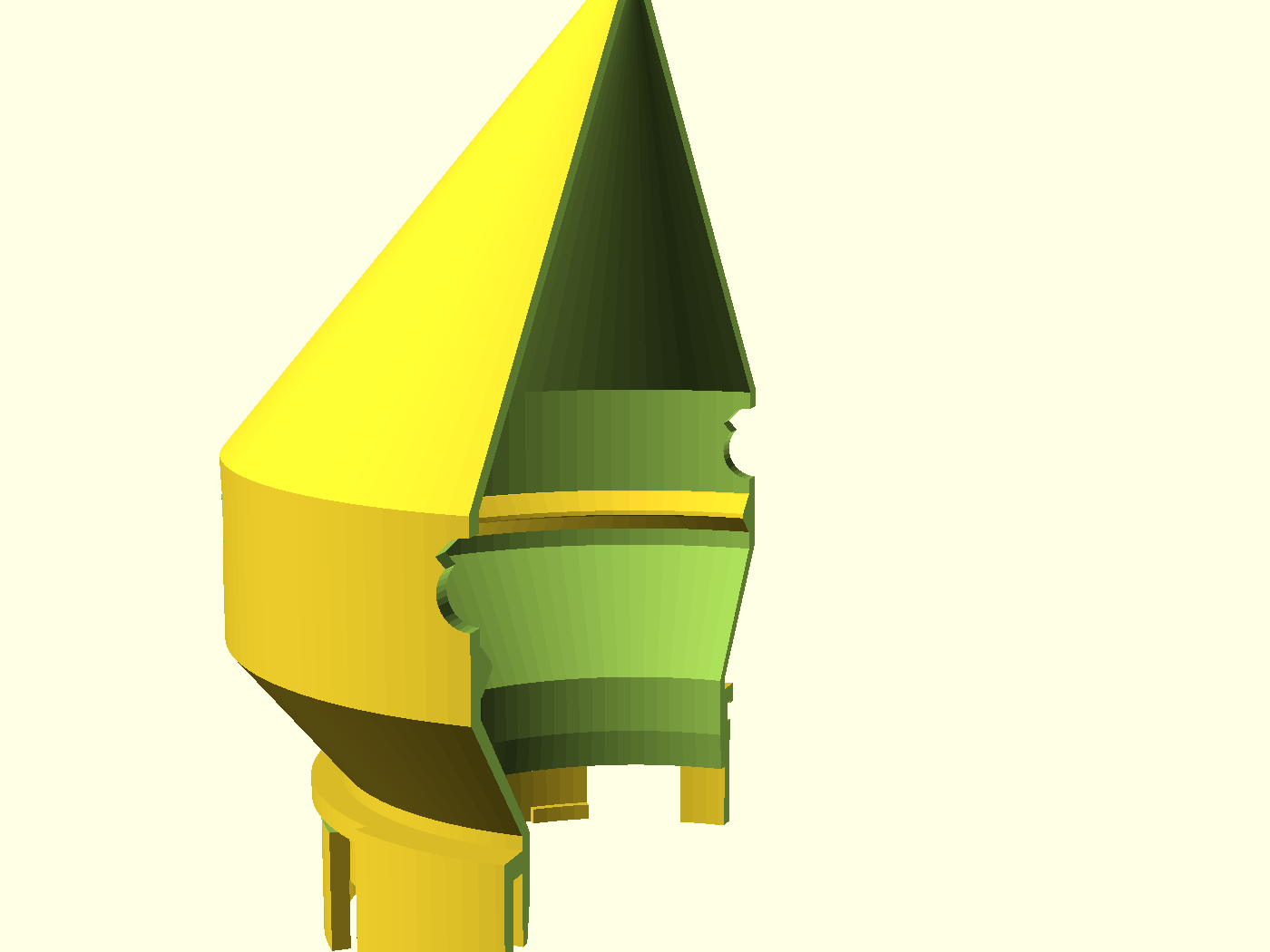
chamber— the den (≈ 116 × 116 × 139 mm at defaults). One genderless port, a hollow opaque bulb, six chimney vents, an internal flank-rub rail.
The four hamster features
- Opaque refuge bulb. Clear tube gives a prey animal nowhere to be unseen. The den is the one NUGGS module deliberately closed and windowless — a solid-walled room to be out of sight in.
- Flank scent-gland rub rail. A Syrian marks territory by dragging the glands on its flanks along a surface (a dwarf uses its belly — different animal, different feature). So the mark it wants is a horizontal ridge at flank height: a rounded full-circle rail on the inner wall, a rub and never a chew edge.
- Chimney vents. A closed refuge condenses worst of all, so the crown carries a ring of vents and warm breath rises out the top. They are teardrops, point up, so each one bridges its own roof and prints with no support — the tell of a design that has actually been sliced.
- Pouch-relief mouth. An animal arriving with both cheek pouches full is wider at the face than the body. The entry is flared so a loaded arrival is funnelled in and never scrapes a lip.
Print settings
- Material: PLA or PETG. It is opaque by nature — that is the point of a refuge; a translucent filament would defeat it.
- Layer height: 0.2 mm.
- Infill: 15–20 % is plenty; the shell does the work.
- Supports: none needed. Every shoulder and the crown sit at ~40° from vertical, the roof closes to a self-supporting point, and the vents are teardrops — the whole part is support-free in the as-modelled orientation.
- Orientation: as modelled — port sectors down on the bed, bulb up. Do not rotate it; the coupling is meant to print standing on its lug tips.
- Brim: yes. The part stands on three small sector tips (~530 mm² contact), so a brim is worth it for a tall part. This is the same first layer every NUGGS module prints on.
- Heads up: it is a substantial part — ~127 g and ~10 h at defaults,
because a refuge is a real room. Shrink
bulb_rif you want it smaller.
Parameters
The handful most worth tuning; the rest are grouped in the Customizer sections
at the top of nuggs-den.scad.
| Parameter | Default | What it does |
|---|---|---|
bore_d | 80 mm | Internal bore — the shared NUGGS headline number. Floored at 70 mm by the coupling library (Syrian entrance minimum). |
port_tol | 0.30 mm | The one fit knob for the quarter-turn joint. Tune on the coupon in ±0.05 steps. |
bulb_r | 58 mm | Half the chamber OD. Bigger = more room, but a taller, heavier print (the crown must stay support-free). |
bulb_wall | 3.0 mm | Chamber shell thickness. |
eq_h | 26 mm | Equator-band height; the vents and rail live on it. |
n_vent | 6 | Number of chimney vents. |
vent_d | 9 mm | Teardrop vent diameter. |
rail_h | 4 mm | How far the flank rub rail reaches into the bulb. |
Override on the command line with, e.g., -D 'bulb_r=50'.
Assembly & use
- Print the coupon first.
nuggs-den-coupon.scadis a bore-clean port stub. Mate two of them (or one to any NUGGS module) and stepport_tolin ±0.05 until the quarter-turn seats snugly without forcing. Set that value innuggs-den.scadbefore printing the den. - Print the den with a brim, no supports, port-side down.
- Fit it onto any NUGGS face: push together, twist a quarter turn either way. It comes apart the same way, with the animal free to leave.
- Place it capping a short run (see Read this first). Give it a handful of bedding; a Syrian will find the rub rail and claim it.