
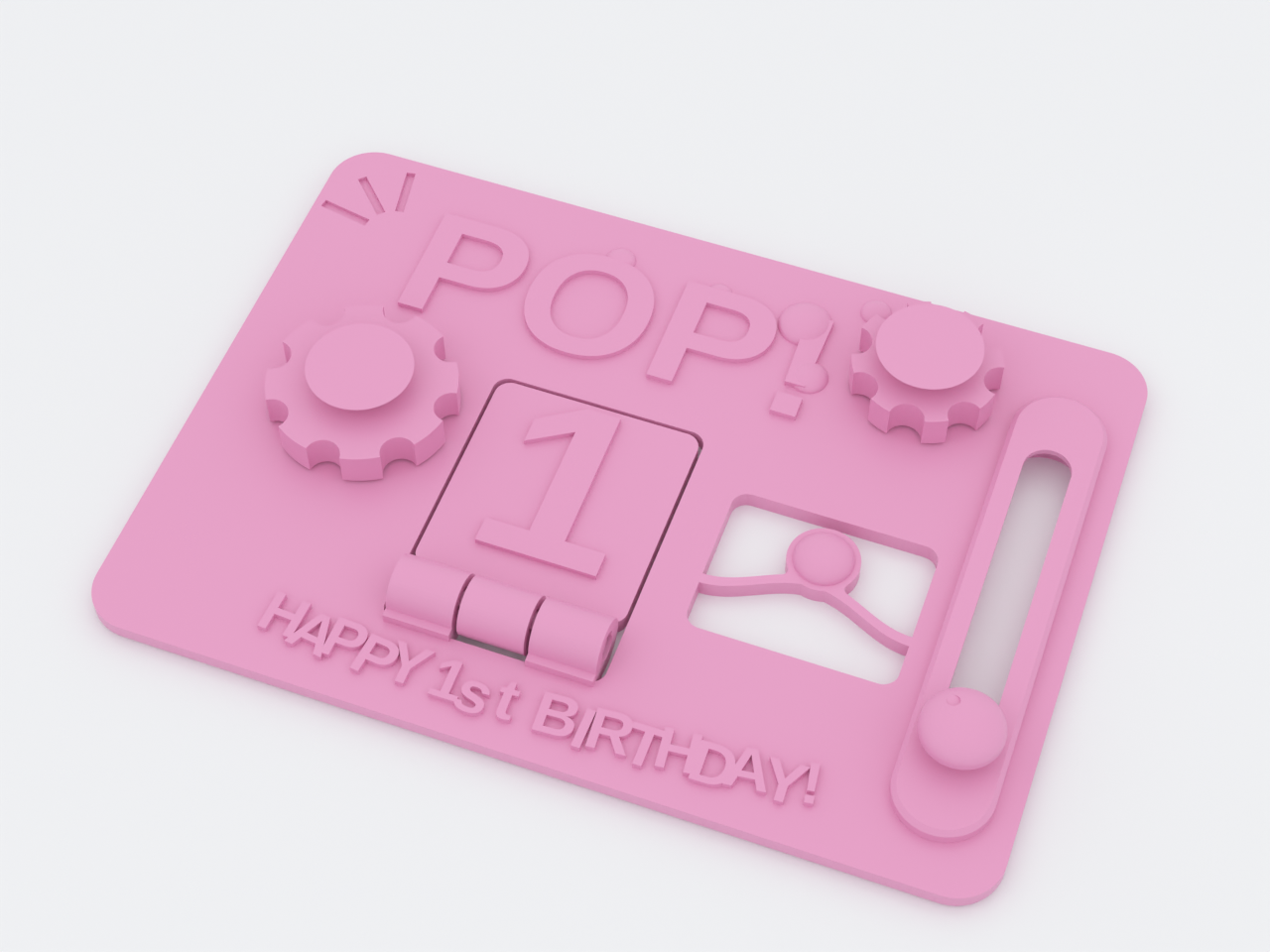
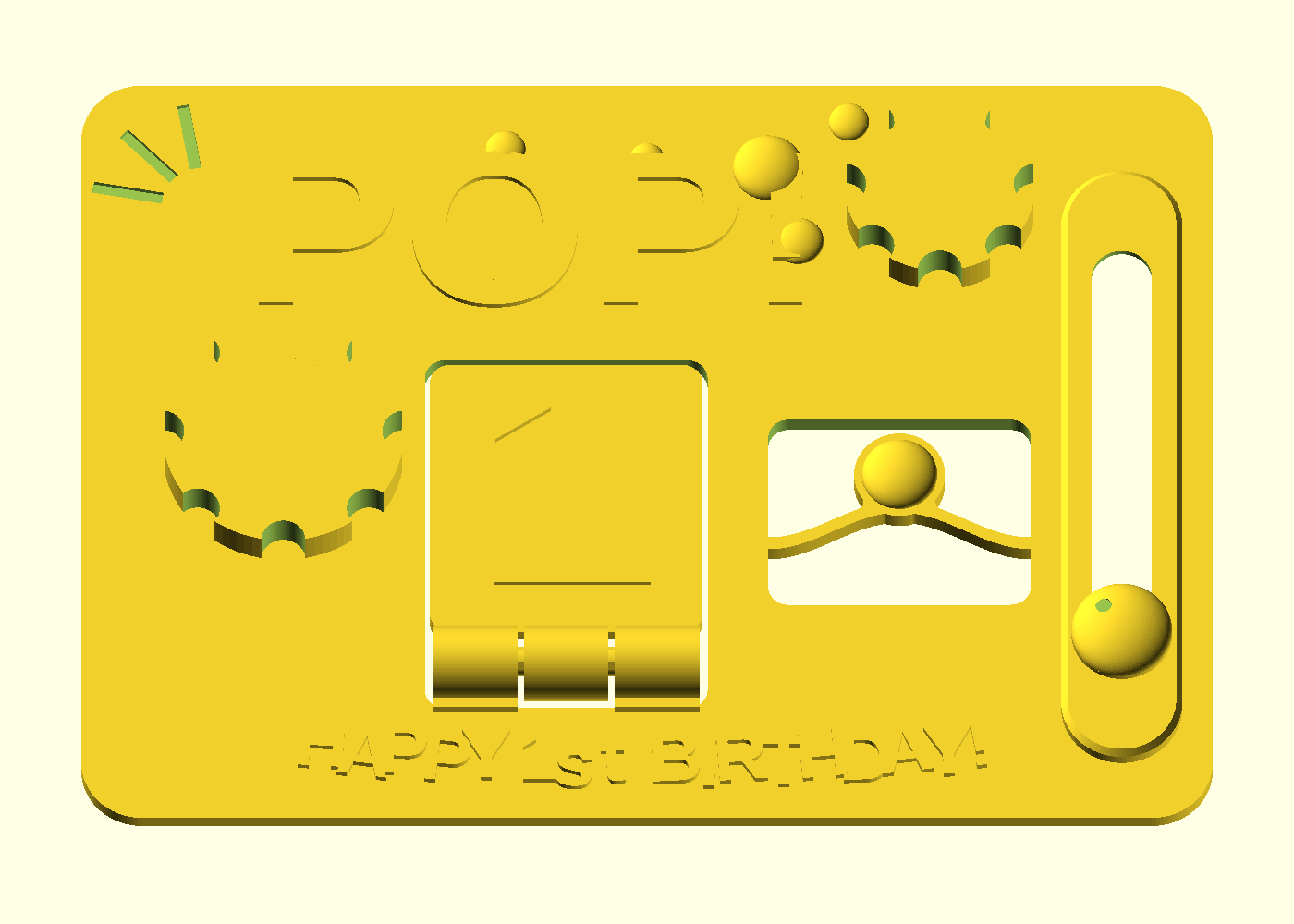
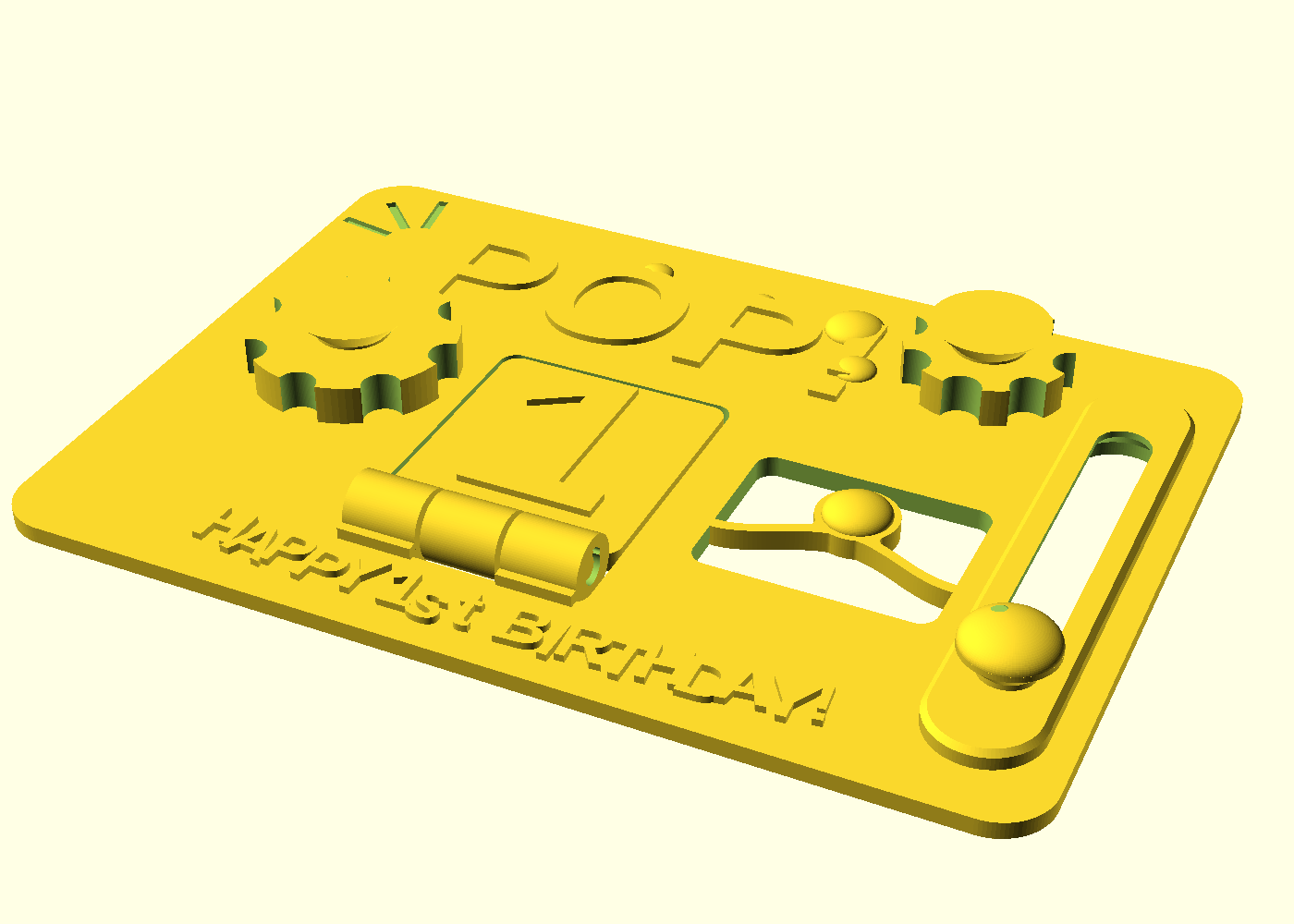
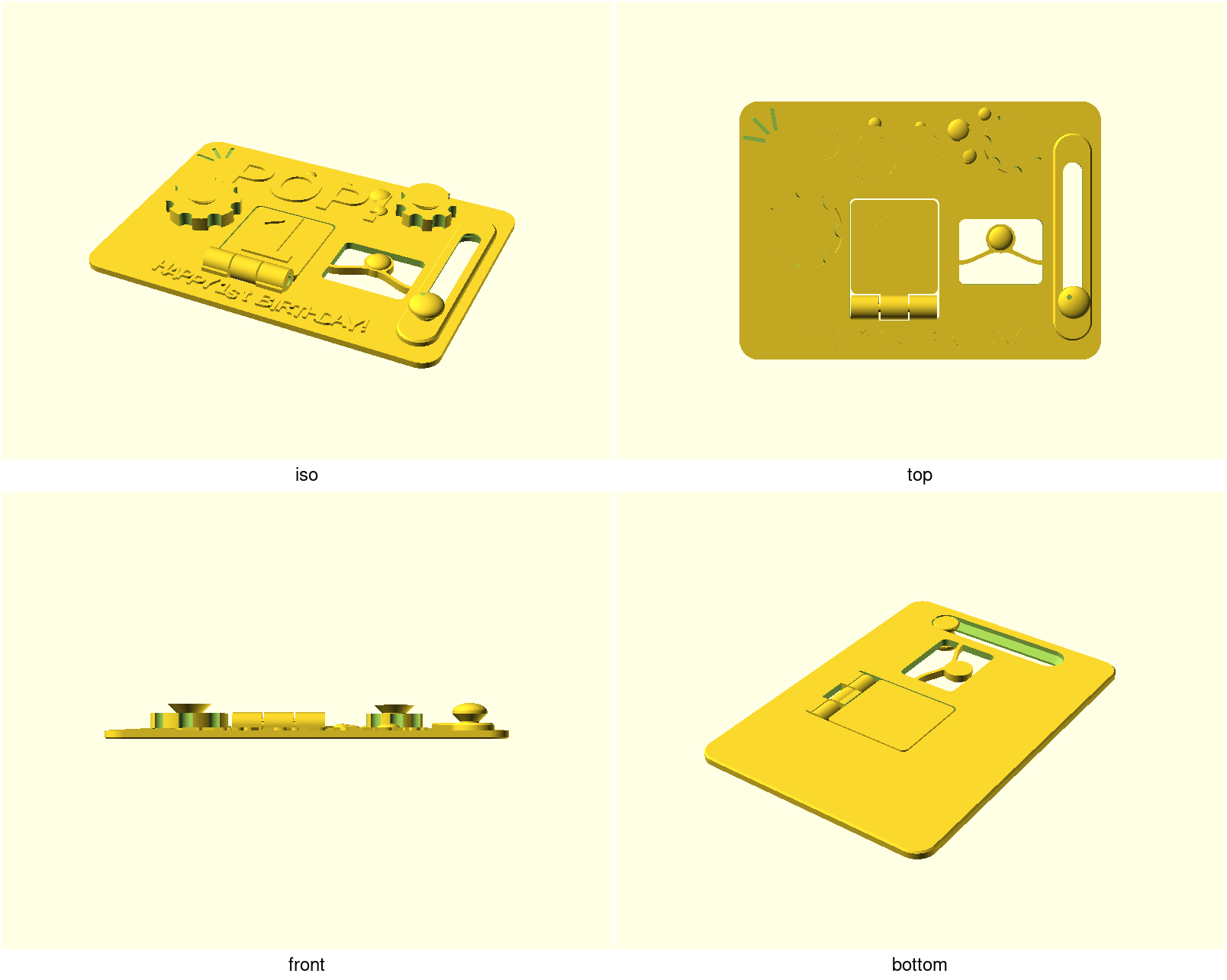
A print-in-place 1st-birthday card that is also a fidget toy — for the parents. The bubble-themed face carries four working mechanisms straight off the print bed, no supports, no assembly: two captive bubble spinners, a bistable "pop" button that snaps between two states, a captive bubble bead gliding on a slider track, and a punched easel flap (the big "1") that folds out on a print-in-place piano hinge to stand the card on a shelf. Personalise it at slice time — the child's name is one parameter — and print the whole thing in ~80 minutes on an MK4-class machine, closer to an hour on a fast Bambu.
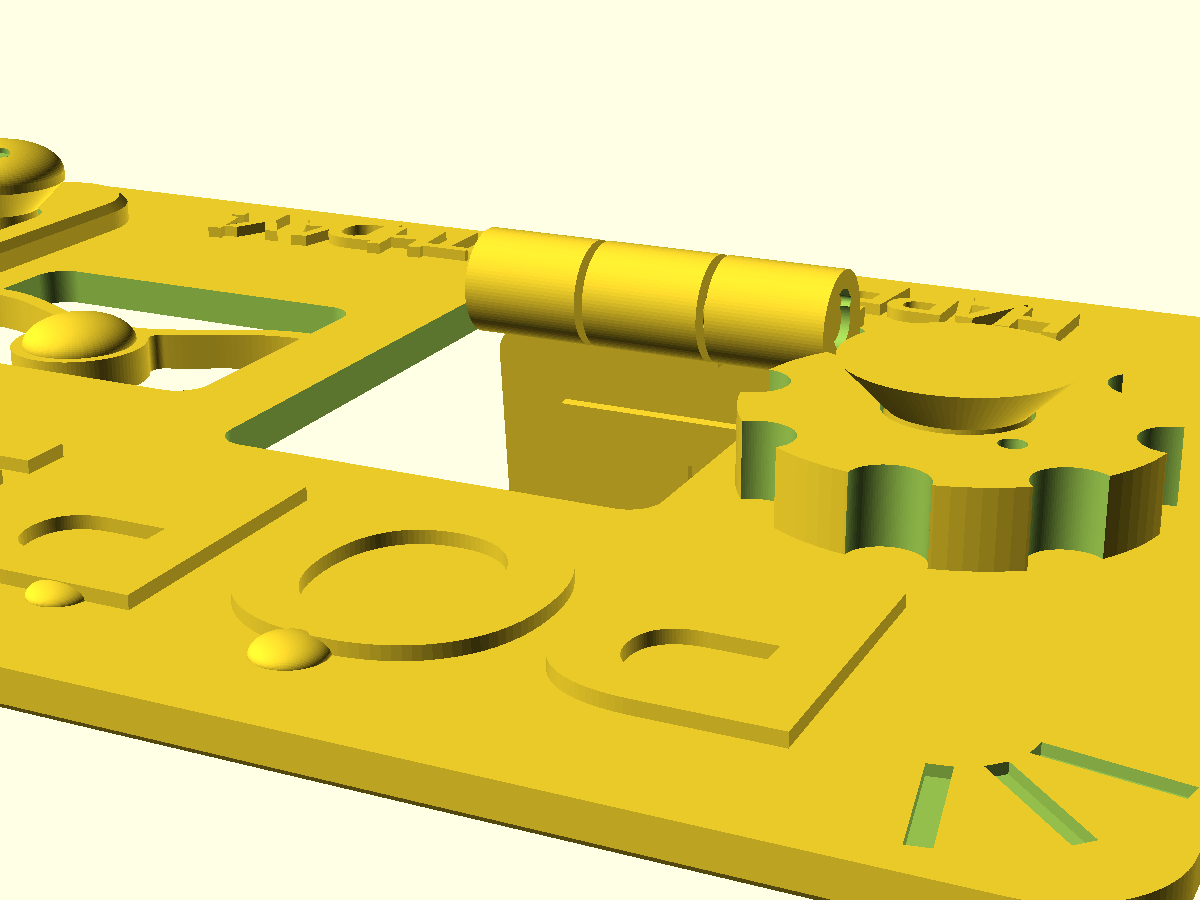
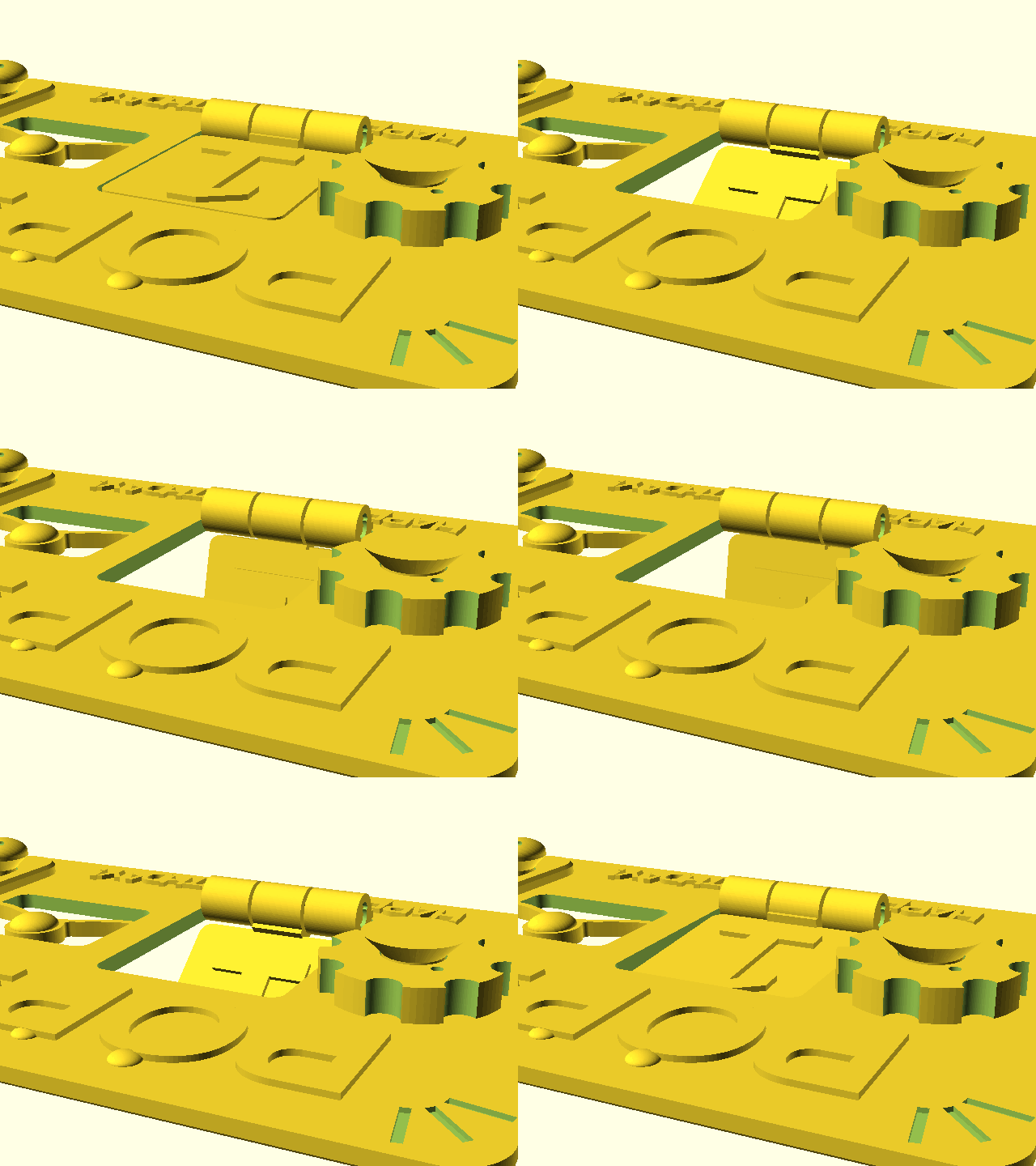
The easel fold in motion — out to its ~97° built-in stop and back; the printed pose is flat (0°).
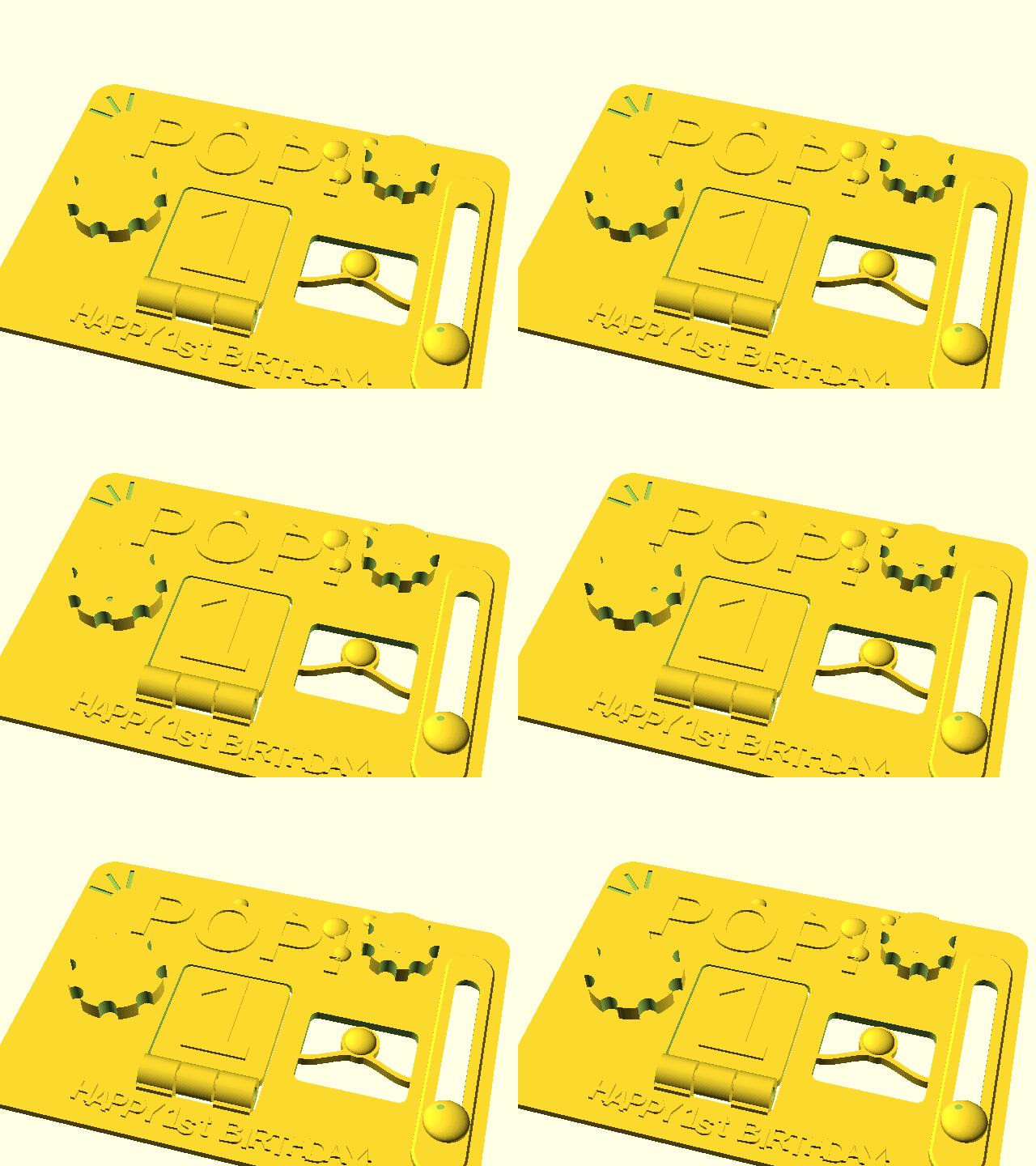
The hot path: the bubble spinners a thumb will work thousands of times, turning.
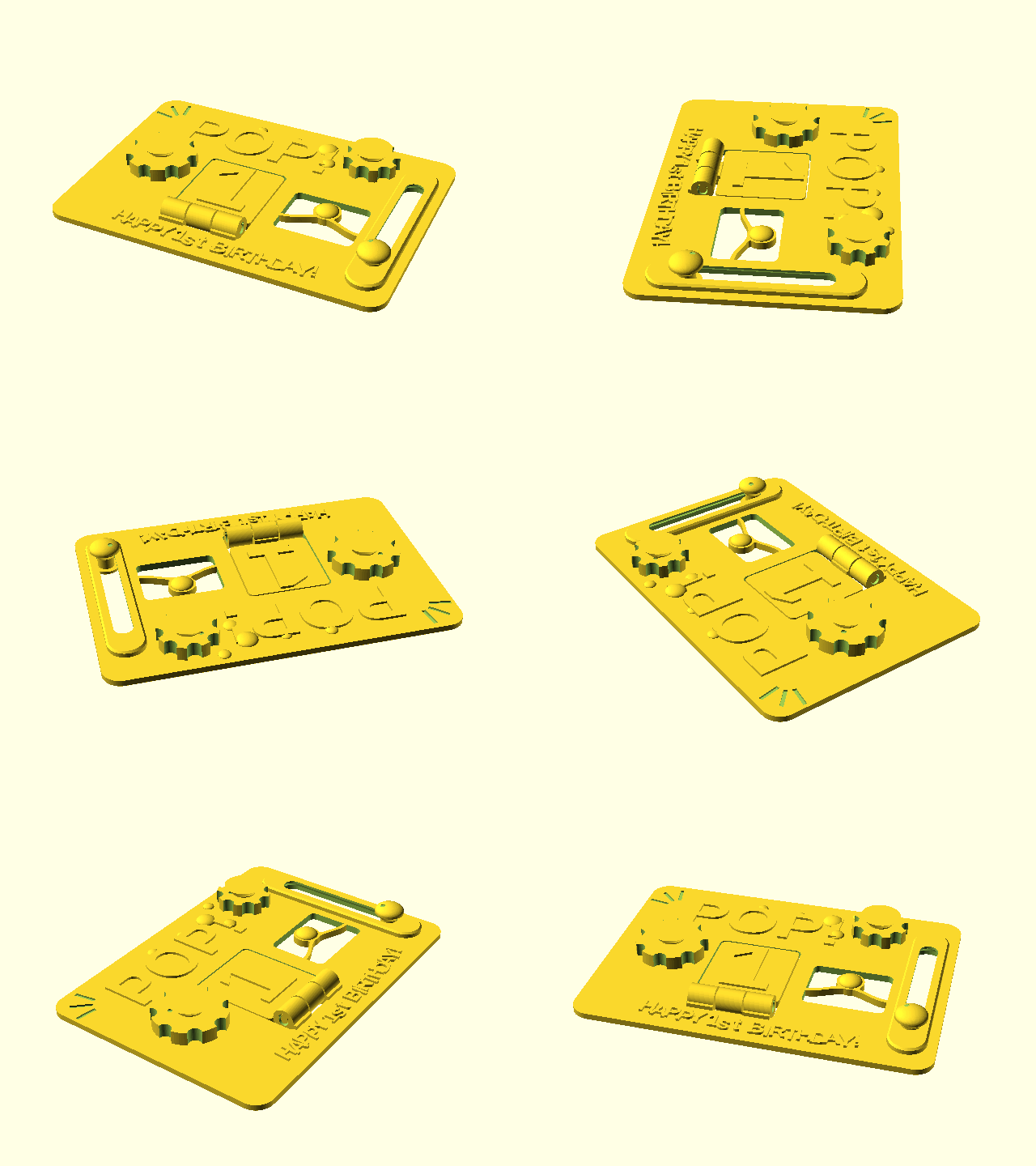
All the way around the bubble — the whole card, edge-on and slim, from every side.
What you get
pop-fidget-card— the card, one print-in-place piece (112 × 80 × 2.4 mm plate; fidgets rise ≤ 8 mm above the face).pop-fidget-card-coupon— a 72 × 56 mm "print this first" tile with all four mechanisms (spinner, slider, hinge, pop button): a ~45-minute tile that saves an ~80-minute reprint, and the only way to feel the button's snap before the card commits. The hinge is why this matters — it's what failed the first real print, so fold the coupon's easel once and confirm it swings clean before you commit the full card.
Print settings
- Material: plain or matte PLA (any color; pastels suit the theme — but skip silk and glitter fills: their strings land exactly in the 0.2 mm rotor gap and the bead slot; an optional filament swap at the first text layer two-tones the lettering — and every other raised feature with it, which is the charm; set the color change at 2.4 mm = layer 13 on the 0.20 profile, since everything raised lifts off the face together)
- Layer height: 0.20 mm (the axial clearances are quantized to it)
- Infill: 15 % (the plate is mostly top/bottom skins)
- Supports: none needed — every overhang is 45° by construction
- Brim: none — the moving parts are bed-anchored islands
- Seam: Back or scarf, not Aligned — the rotor bores and the hinge barrels are mating surfaces (the pin rotates inside the barrels), and an aligned seam stacks a ridge down the bore that stiffens the spin or the fold. If a rotor stays stiff after break-in, also set gap-closing to 0.1 mm (the 0.2 mm default merges exactly this clearance) and re-check on the coupon; that 0.1 mm also covers the flap's bottom perimeter, so a stiff first fold benefits too
- Orientation: as modeled, face up
- First motion — break it in before you gift it: spin both rotors and push the bead firmly once (this shears the deliberate break-free welds), pop the button a few times, fold the easel out to its stop (~76–80° leg angle → the card leans ~12–15° back off vertical). The first fold is firm — that's the bottom layer's squish, not a fused hinge; fold straight out in the fold plane and it frees. Doing this the night before means the parents receive a working toy, and a mushy button surfaces at your desk, not at the party
A note for gift-givers: this is a keepsake for the grown-ups' shelf. It is print-in-place, so nothing detaches by design, but it is not a teether — don't hand it to the birthday kid unsupervised.
Parameters
| Parameter | Default | What it does |
|---|---|---|
card_name | "" | The child's name — set at slice time with -D 'card_name="ALEX"'; empty prints the generic card. Setting a name auto-shortens the greeting (drops "BIRTHDAY") so HAPPY 1st, <name>! fits at full stroke width for names up to ~15 letters; a longer name fails the render with a clear error (shorten the name, or set greeting_named). The committed previews are all the generic card, so slice-preview your name once before committing the 2½-hour print — it's the one line no preview here can show you |
greeting | HAPPY 1st BIRTHDAY | Bottom line on the unnamed card (! appended) |
greeting_named | HAPPY 1st | Bottom line on the named card — the name and ! are appended (HAPPY 1st, ALEX!) |
spinner_count | 2 | Bubble spinners (0–2) — drop to 1 to shave a measured ~11 minutes, the only time lever that pays (NOTES.md has the sweep; infill and card size barely move the meter) |
xy_tol | 0.21 mm | Spinner bore ↔ post radial gap — tune on the coupon (field-set from 0.20) |
with_easel | true | The punched "1" easel flap + hinge. Set false to print the card with no fold-out stand (the window fills solid) |
tog_beam_t | 1.3 mm | Pop-button snap-beam thickness — 1.3 is PLA-tuned (softer snap); PETG can use 1.5 |
slide_tol | 0.25 mm | Bead stem ↔ slot sliding gap per side |
hinge_clear | 0.4 mm | Easel hinge pin clearance on every bore surface |
card_w / card_h | 112 / 80 mm | Card face size |
All parameters are at the top of pop-fidget-card.scad, grouped in
Customizer sections; override on the command line with -D 'name=value'.
Assembly & use
Nothing to assemble. Print the coupon first if this is your first run on a printer (tuning order and steps are in NOTES.md "Print this first"), then the card. After the break-free first motions everything runs free: the spinners flick from the rim scallops, the pop button clicks between its two states, the bead glides between the track ends, and the easel flap folds out to its built-in stop so the card stands leaning back ~12–15° on a shelf. One shelf habit: park the button flat (its as-printed state) — a PLA arch left popped for months slowly creeps and the snap softens; parked flat it will still snap for the second birthday. Printing it "stronger" doesn't help: a deeper dome raises snap force and stored strain together. If a fit is off, retune its parameter on the coupon and reprint. This design has one real print behind it (2026-08-22, PLA) — the field-test log in NOTES.md records what it found and what changed since. v0.2 addressed a PLA-softer button beam, a sliceable bubble-shine, and an auto-shortened named greeting; v0.3 finished the hinge fix — the fold-out tongue is now a full-thickness rigid link (the pin hinge does all the folding), so there is no thin living hinge to crack in PLA.