

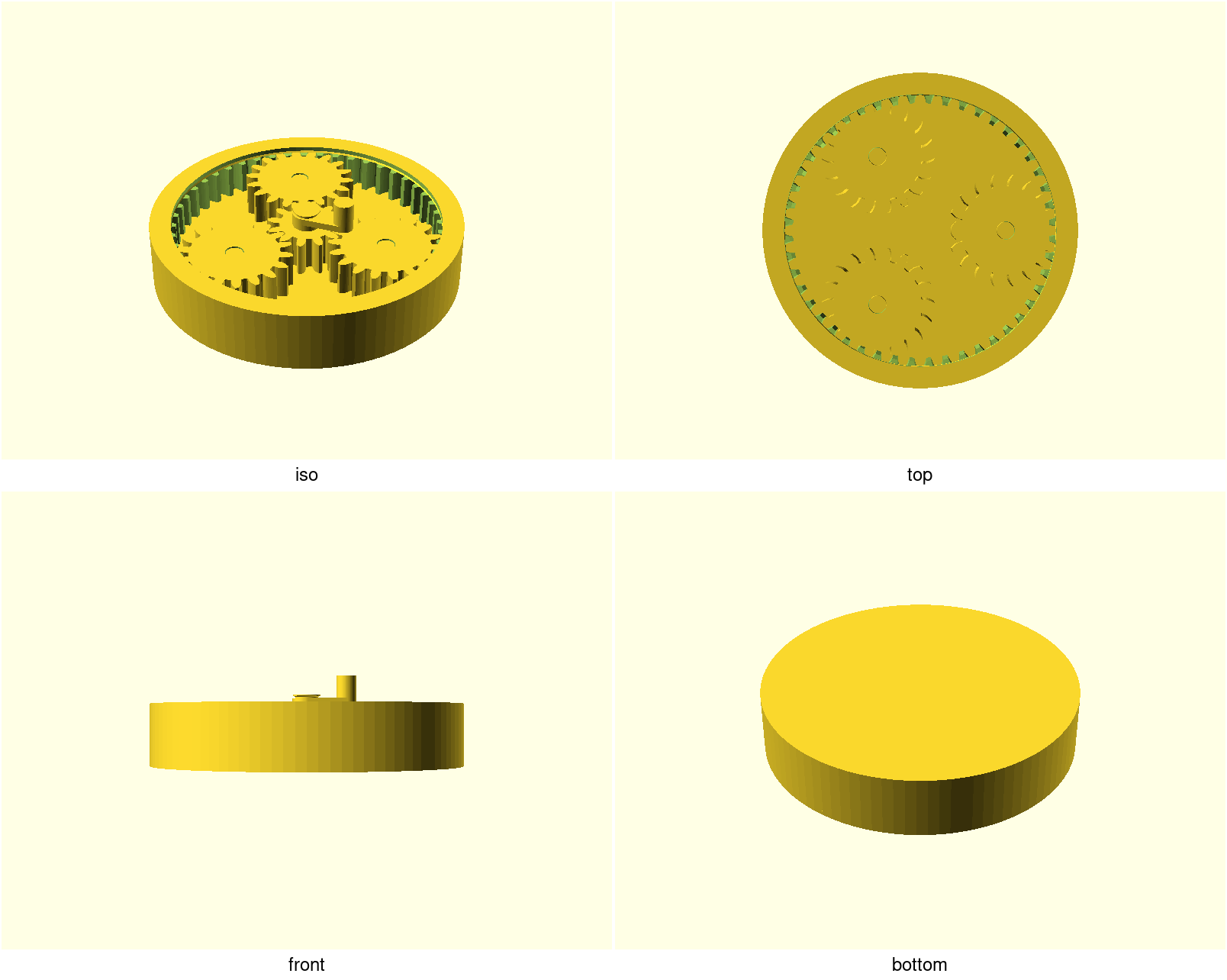
A planetary (epicyclic) gear train — sun gear, three planets, internal ring — printed as one assembled part, no supports, no assembly. Turn the sun's molded crank and the carrier walks the planets round the ring at a 5:1 reduction. The catalog's first toothed-gear design: mesh phasing, tooth backlash and first-motion clearances all printed in place, proved by boolean fit gates rather than eyeballed.
What you get
pip-planetary— the assembled unit, Ø110 × 32 mm, ~9 h / 103 g. Base ring housing with the internal gear teeth cut into its wall, the carrier disc and pins, the sun with its crank, and three planets — all captive, all printed in place.pip-planetary-coupon— the print-this-first coupon (~2 h 50 m, 32 g — a third of the full print): one pocket of the train (sun + one planet + the ring segment they engage) at full production tolerances, for tuning the mesh and pin fit on your printer. It cannot be smaller and still tell the truth: the sun and planet alone outweigh a 20-minute print at module 2, so the coupon keeps the real gears and drops two-thirds of the structure instead.
How it works
The ring is fixed (part of the housing), the sun is the input (its crank), and the carrier is the output — the Willis arrangement, ratio 1 + Zr/Zs = 1 + 48/12 = 5:1. Turn the crank five times and the train walks round once. The three planets space at exactly 120° because the tooth counts satisfy both assembly conditions (48 = 12 + 2·18, and (12+48)/3 = 20, an integer) — all three mesh the sun and the ring simultaneously, which is the alignment constraint this design exists to demonstrate.
Backlash is tooth thinning (each gear cut 0.125 mm thin, 0.25 mm total in the mesh), never center distance: each planet meshes the sun outside and the ring inside at one fixed 30 mm axis radius, so moving the centers would open one mesh by exactly what it closes the other.
Print settings
- Material: PLA or PETG (PETG if you'll cycle it repeatedly)
- Layer height: 0.2 mm — the axial gaps (0.4 mm everywhere) are whole
layers by design; a different layer height needs
z_gap_layersre-derived - Infill: 20%, gyroid
- Supports: none — the whole stack prints bottom-up on material
- Orientation: flat on the base plate, exactly as rendered
Parameters
| Parameter | Default | What it does |
|---|---|---|
backlash_gear | 0.125 mm | Tooth-thinning per gear; total mesh backlash is 2× |
pin_diam_clear | 0.4 mm | Diametral clearance, planet bore ↔ carrier pin |
gear_module | 2.0 | Tooth size — tooth depth ≈ 4.5 mm at module 2 |
face_w | 12 mm | Gear face width |
z_gap_layers | 2 | Axial gaps in whole 0.2 mm layers (sag-limited) |
All parameters are at the top of pip-planetary.scad, grouped in Customizer
sections; override on the command line with -D 'backlash_gear=0.15'.
Assembly & use
None — it comes off the plate assembled. Give the sun's crank a firm first
turn to shear the break-free welds (the deliberate 0.4 mm gaps' first-layer
micro-fusion), then it turns freely. If the mesh feels stiff, print the coupon
and raise backlash_gear by 0.025; if a planet seizes on its pin, raise
pin_diam_clear by 0.1 — see NOTES.md "Print this first" for the full tuning
order.