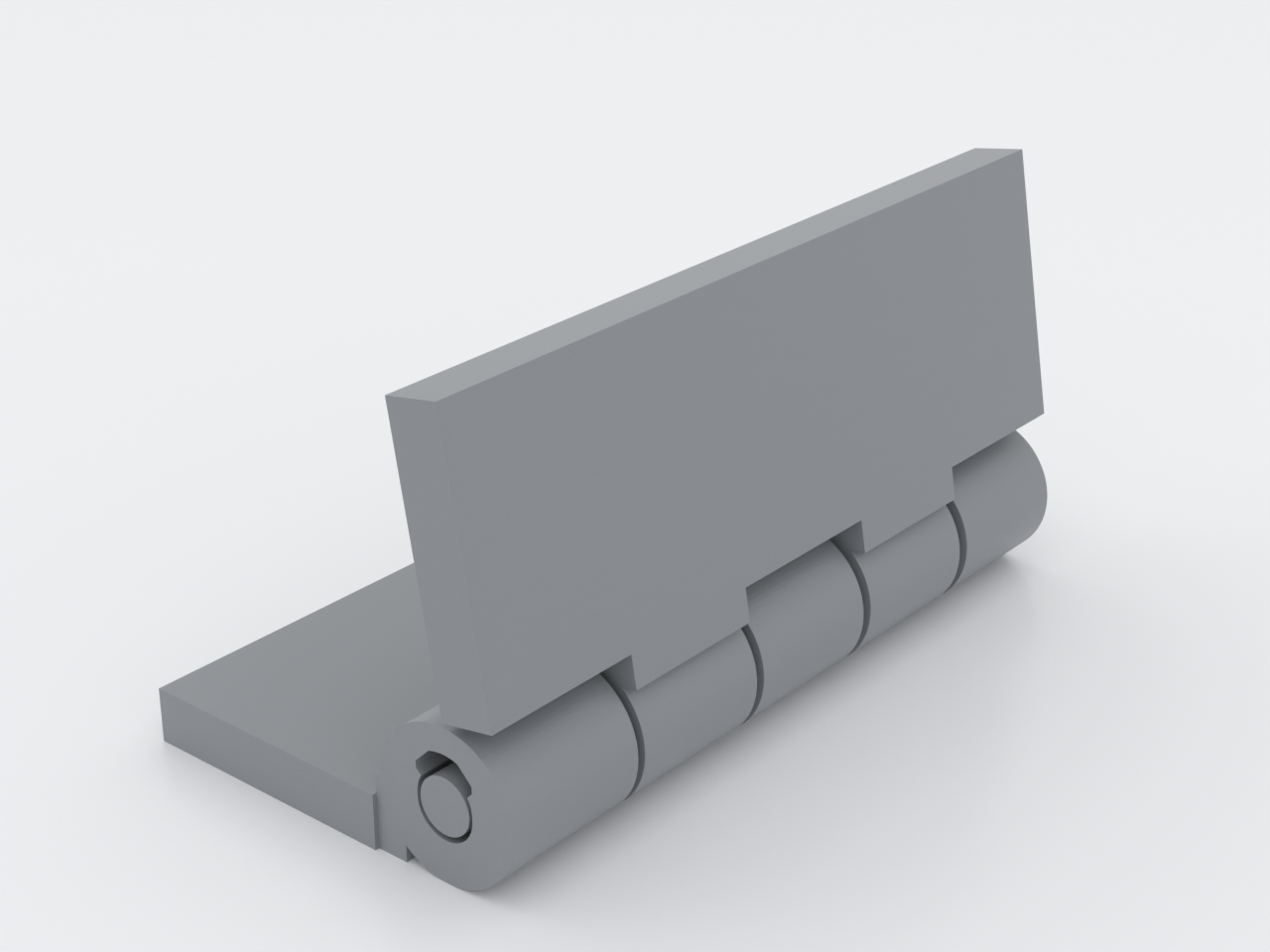
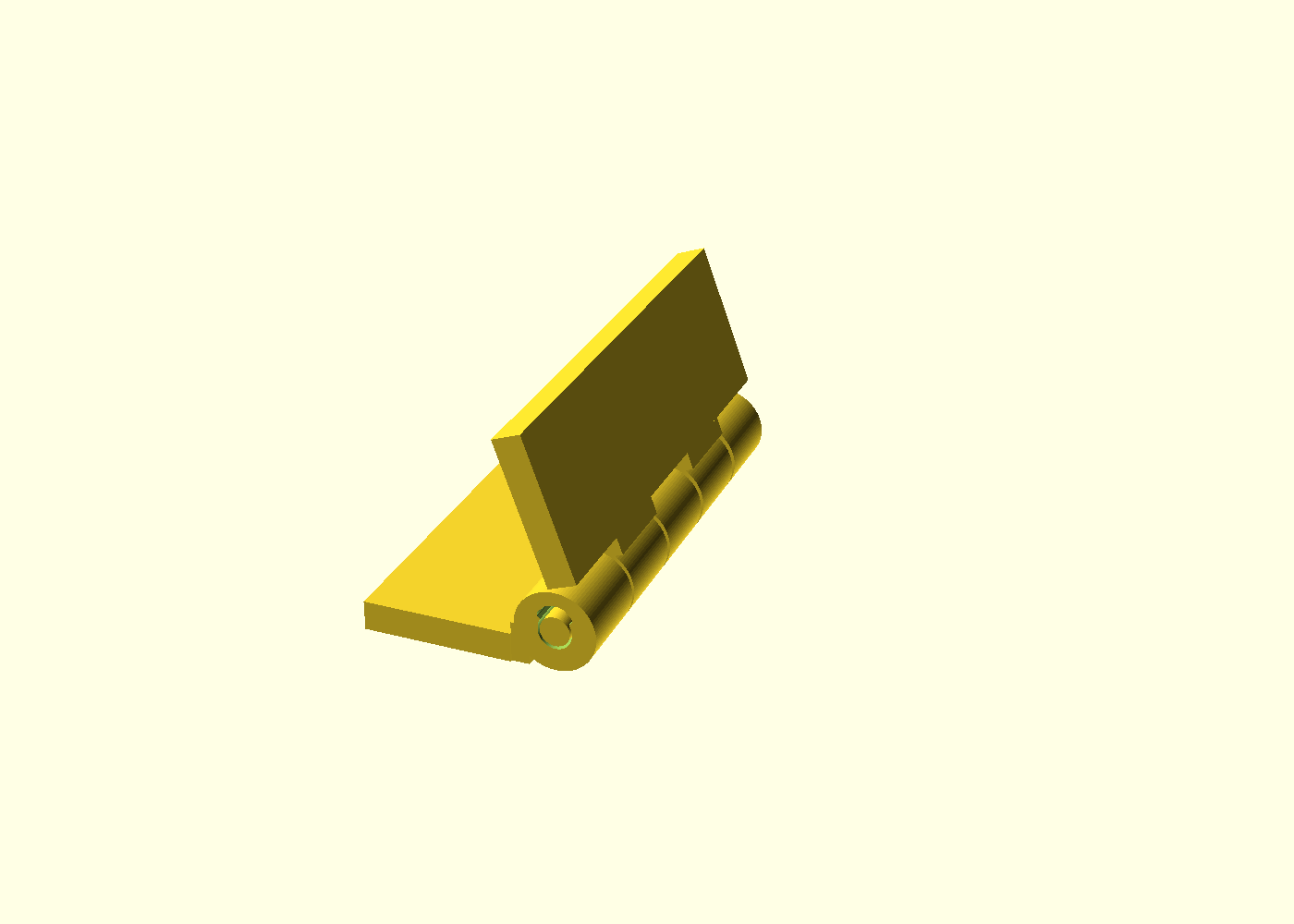
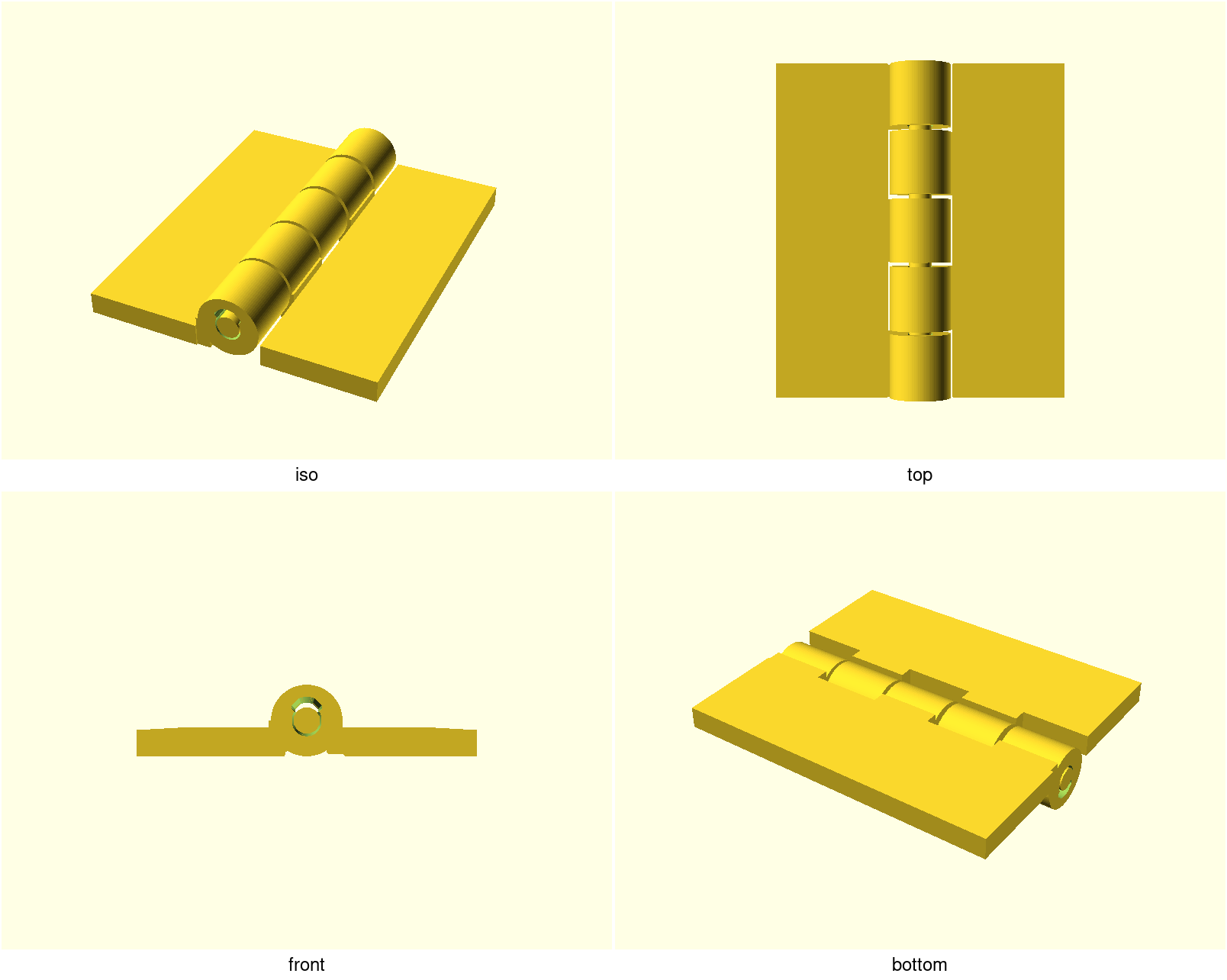
A multi-knuckle piano hinge that comes off the print bed already assembled and
swinging — three separate bodies (two leaves and a free pin) printed in place,
no supports, no assembly. It's built on the repo's lib/print-in-place.scad
hinge profile and adds the piano-hinge-specific defenses against tolerance
stacking (docs/advanced-techniques.md, Domain 3).
Folded (preview pose):
What you get
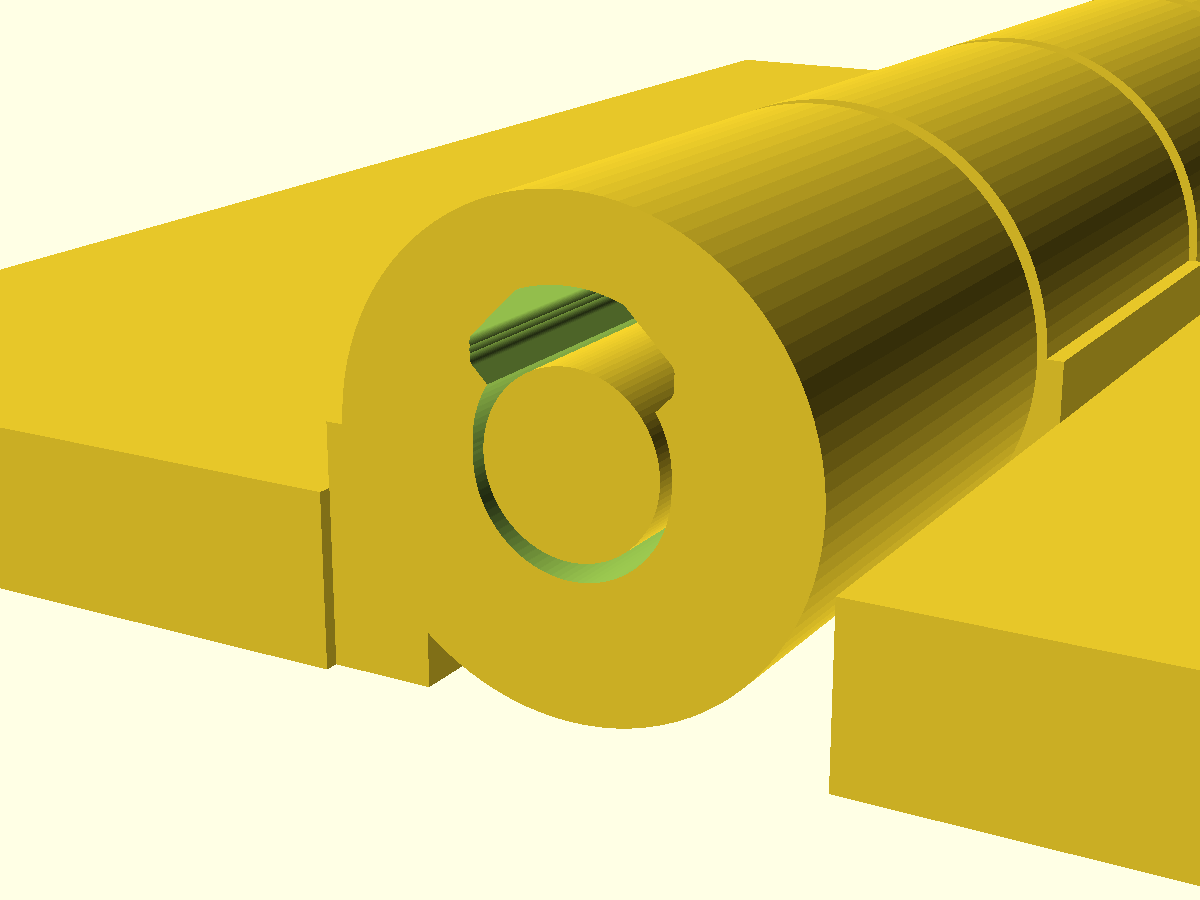
pip-piano-hinge— one print, 60 mm long, rendering as 3 separate bodies: leaf A, leaf B, and the free pin. The pin is round on purpose: the teardrop pin you'd expect from the library jams against the bore's flanks past a few degrees — rotation needs a rotationally symmetric pin riding the bore's circular zone (the teardrop stays where it earns its keep, as the bore's support-free roof). The committedfold90check proves the swing on the mesh, not just in a pose.
Print settings
- Material: PLA/PETG both fine (the pin bore is a sliding fit, not a live flex)
- Layer height: 0.2 mm (the radial clearance is split xy/z and the z gap is snapped to whole layers — changing layer height re-derives it)
- Infill: 20–40 %
- Supports: none needed
- Orientation: flat, as modelled (leaves on the bed, barrels on top, pin axis horizontal). The bore roofs are 45° teardrops and print supportless.
- First use: work the hinge back and forth once to free the knuckles.
The bore is grown from the pin's profile by a true offset(r = clear_xy) —
not a scaled teardrop, which would leave the flank planes coincident and
weld the print. Clearances are split per the physics: 0.25 mm on the
vertical (spread-limited) surfaces, 0.40 mm — two whole layers — on the
horizontal (sag-limited) roof and floor. Tolerance stacking is defeated with a
per-knuckle axial clearance (0.65 → 0.95 mm, growing along the run) plus a
leaf_gap between each leaf and the opposing barrels. Committed checks prove
all three bodies clear, the ≥90° fold, and that the sliced STL is really three
separate bodies (ci.fitchecks, ci.fusecheck).
Parameters
| Parameter | Default | What it does |
|---|---|---|
clear_xy | 0.25 mm | THE tunable: radial clearance on vertical bore surfaces (≥ 0.25 guarded). clear_z derives from it on whole layers |
layer_h | 0.2 mm | print layer height — drives the clear_z = ceil(max(clear_xy, layer_h)/layer_h)·layer_h snap |
axial_gap | 0.6 mm | base axial gap between knuckles (2× bead spread + one extrusion width) |
axial_err | 0.05 mm | stacking term: each knuckle's gap grows by (2k+1)·axial_err along the run |
leaf_gap | 0.4 mm | gap between a leaf and the opposing barrels |
knuckles | 5 | number of knuckles (≥ 3), alternating leaves |
hinge_len | 60 mm | overall length |
pin_d | 4 mm | pin diameter (round) |
All parameters are at the top of pip-piano-hinge.scad; override with
-D 'clear_xy=0.3'. If a knuckle binds, reprint with clear_xy +0.05.