

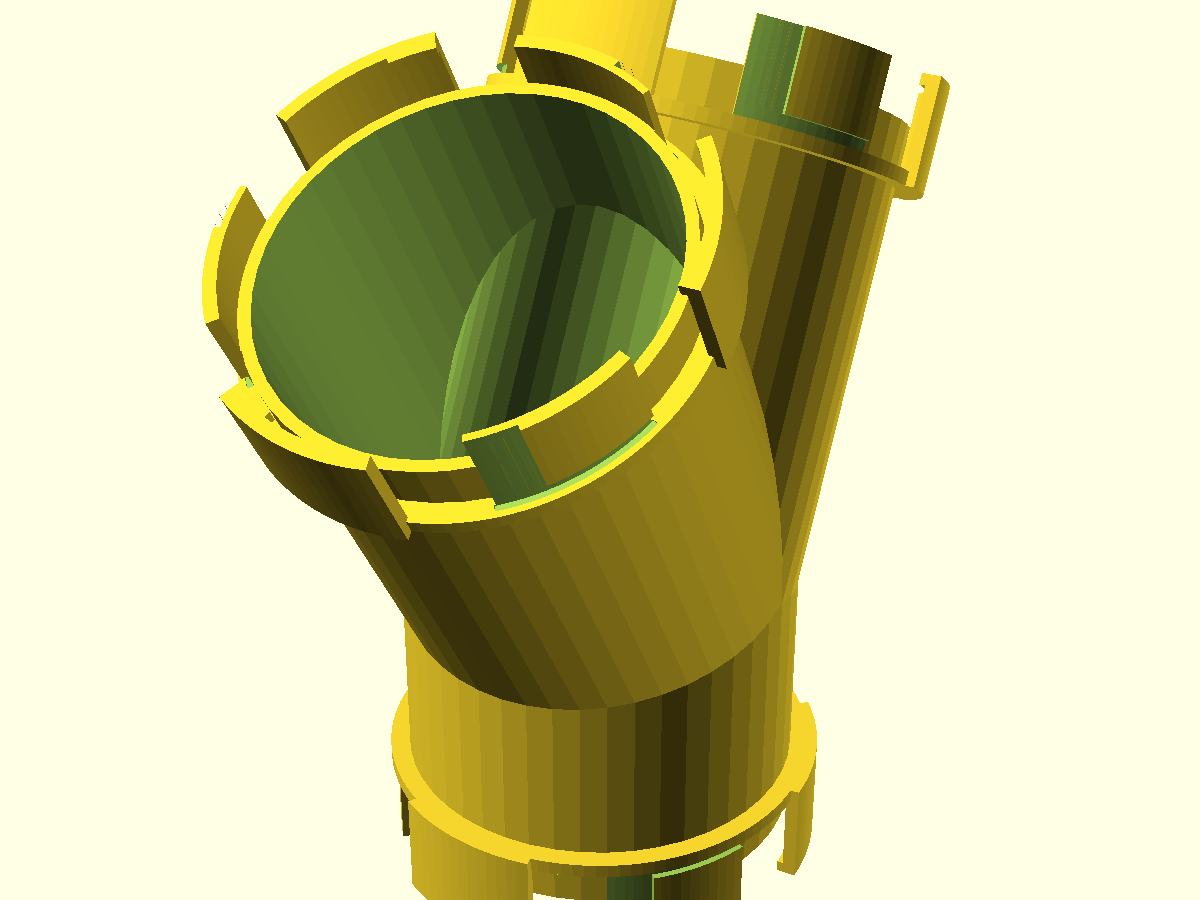
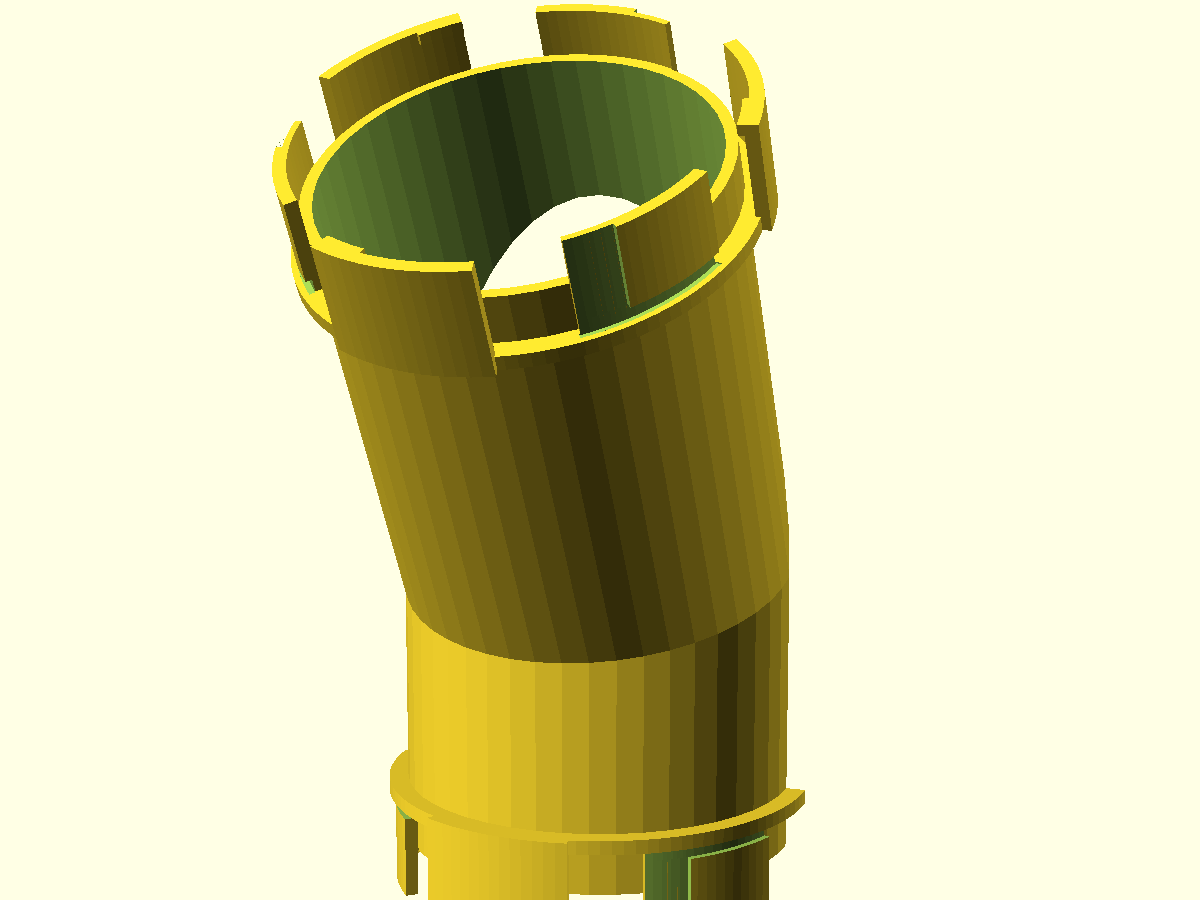
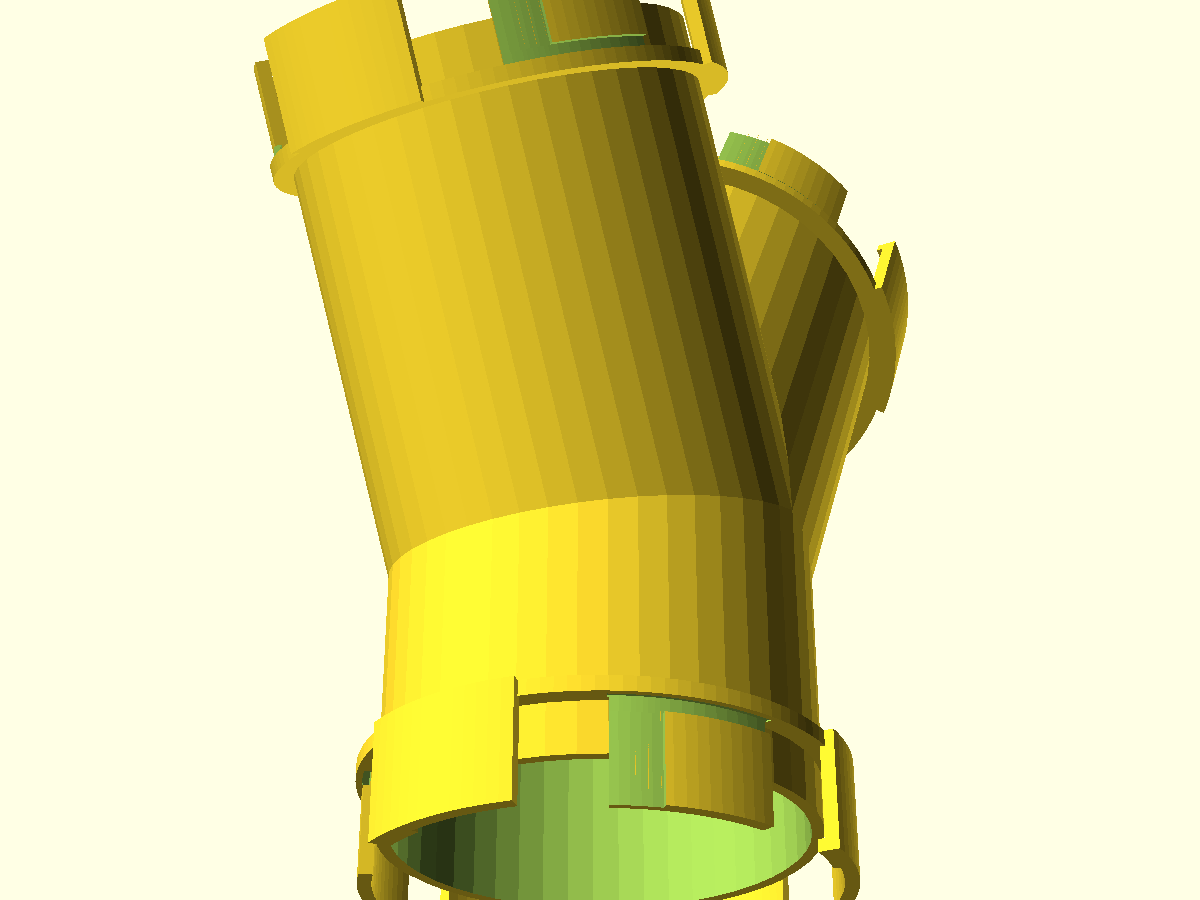
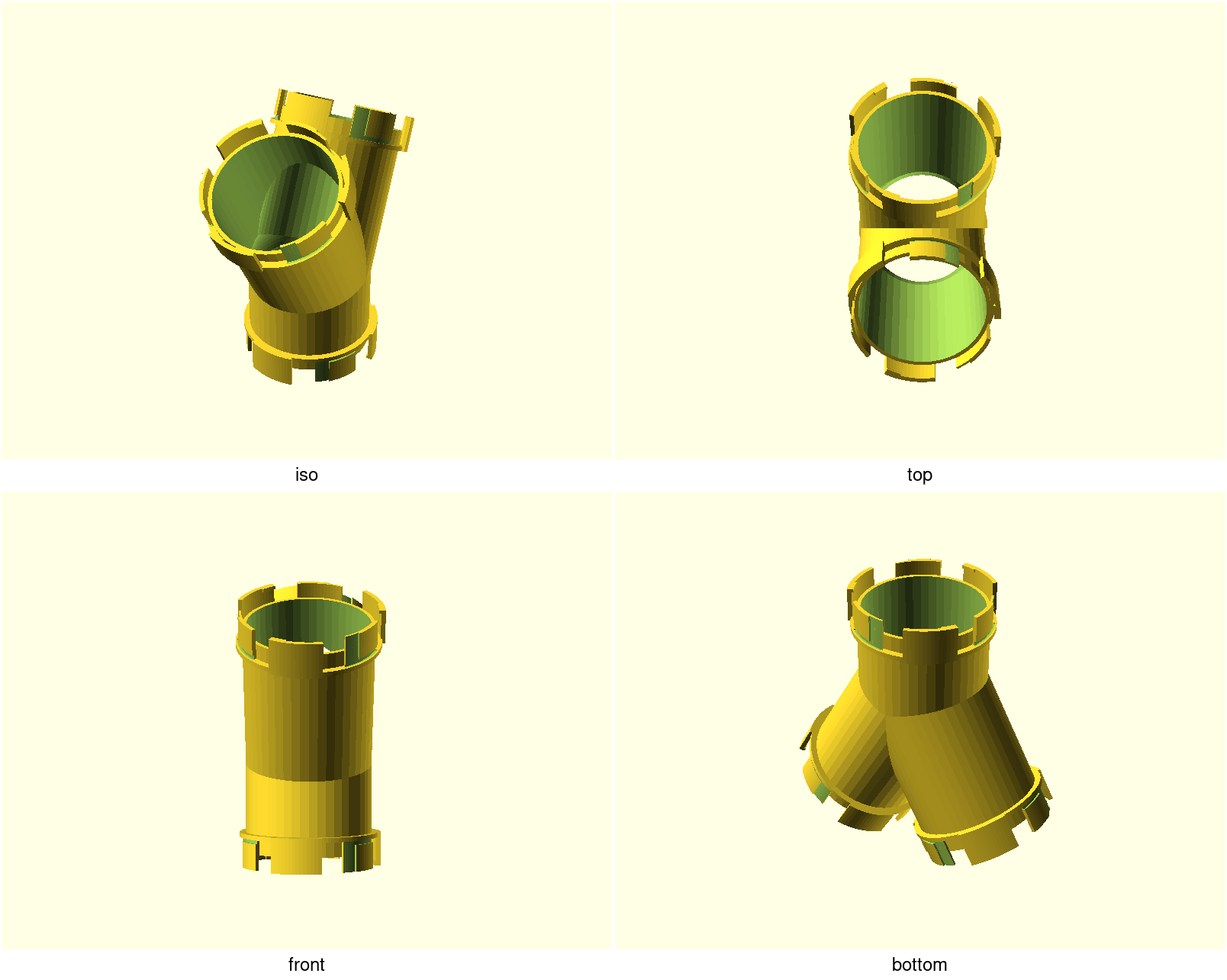
The branch the N.U.G.G.S. run was missing: a Y-junction that splits one 80 mm-bore hamster-tunnel path into two. One inlet port, two symmetric outlets at a 60° included angle, and all three faces carry the standard genderless quarter-turn NUGGS port — so both branches drop into any existing run of straights, elbows and bulkheads, and twist shut a quarter turn either way. The bore stays a continuous, smooth 80 mm passage through the fork: a NUGGS welfare non-negotiable, because a live animal travels this junction and any interior ledge is a hazard.
Branching was the one topology the ecosystem could not do — every other NUGGS module is a two-port single-path part. This is it.
What you get
One printable part: a Y-shaped tube with a NUGGS port on every face, printed as a single piece.
ysplit— the Y-splitter (approx. 95 × 193 × 191 mm print-pose envelope; ~200 g at the slicer defaults below). Inherits every coupling dimension from the NUGGS standard (lib/nuggs-coupling.scad): 80 mm bore, 84.8 mm tube OD, 96.8 mm coupling-ring OD.nuggs-y-splitter-coupon.scad— the print-this-first fit coupon (see Print settings).
The cutaway view (-D part="cutaway") is a review preview, not a print.
Print settings
The splitter prints standing on its inlet port, the same orientation as the NUGGS straight and elbow — the three coupling-sector tips are the bed contact, the bore vertical at the inlet, both branches rising at 30°.
- Material: PLA or PETG.
- Layer height: 0.2 mm.
- Infill: 15–20 % (walls carry the load; the tube is 2.4 mm / 6 perimeters).
- Supports: none — by construction, not by luck. Every junction surface stands 30° from vertical, under the ~45° supportless ceiling a vertically-printed enclosed bore allows; measured off the exported mesh, zero interior-bore surface needs support. What overhang printcheck flags (3 %) is exterior: bed-side port faces and branch sector tips.
- Orientation: inlet port down, bore vertical at the inlet. printcheck confirms this is as good as any axis-aligned alternative.
- Brim: recommended. The part stands on three sector tips, so the first-layer contact patch is small (~527 mm²); a brim keeps it planted.
- Print this first:
nuggs-y-splitter-coupon.scad— two production port stubs side by side. Mate them to each other (quarter-turn, firm click, no rattle) and caliper the bore: under 79.0 mm means your printer is shrinking — raiseport_tolin ±0.05 steps on the coupon until the pair mates, then set the same value in the splitter before committing ~200 g of filament to the full print. - Bed: the print-pose envelope is 95 × 193 × 191 mm. That is deliberately
inside a 256 × 256 × 256 bed and under the 250 mm height a stock slicer
profile enforces — raising
inlet_lenpast ~64 mm pushes the part over that wall (asserted).
At the committed quality the part scores 76/100 — printable with caveats in
printcheck (watertight, one body, no critical issues; the caveats are the 3 %
exterior overhang and the small bed-contact patch, both inherent and both
addressed above).
Parameters
All parameters are at the top of nuggs-y-splitter.scad, grouped in Customizer
sections; override on the command line with -D 'branch_half=25'.
| Parameter | Default | What it does |
|---|---|---|
branch_half | 30° | Each outlet's angle off the inlet axis (60° included fork). 30° keeps every junction surface supportless; the allowed 20–40° range is asserted. |
inlet_len | 60 mm | Inlet axis length, fork centre to coupling face. Sized to the bed (see Print settings); the brief's assumed ~80 mm did not fit a 250 mm-tall profile. |
port_stub | 16 mm | Straight full-round shell each port fuses to, past the coupling collar. |
bore_d | 80 mm | Internal bore, the headline number. A NUGGS-standard value; asserted ≥ 70 mm (welfare floor). |
wall | 2.4 mm | Tube shell thickness (6 perimeters at a 0.4 mm nozzle). |
port_tol | 0.30 mm | The coupling fit clearance — owned by the NUGGS standard, tuned on the coupon, not re-tuned here. |
branch_len (the outlet arms) is derived, not a knob: it is pinned from
below by the assembly clearance — a mating module sliding onto one outlet
sweeps its sector tips past that face, and the other outlet's coupling ring has
to stay out of the sweep — so the arms are as short as coupling a neighbour
allows, never shorter. The coupling parameters (lug_r, port_proj, n_lug,
lug_deg, twist_deg, …) are the NUGGS standard defaults: change them and
this splitter no longer mates with other NUGGS modules. They are exposed for
the Customizer, not for tuning.
Assembly & use
- Into a run: push any port onto any other NUGGS port and twist a quarter turn either way; the bayonet ribs seat. The joint is genderless, so orientation never has to be got right, and it is hand-releasable.
- Branching: the inlet goes where the run was; each outlet takes its own run of straights, elbows and endcaps. Both outlets clock independently, so the two paths can leave the fork in any two directions in the fork plane.
- Welfare: per the NUGGS charter a junction is not a break in an
enclosed run — count both branches as continuously enclosed bore when you
plan run lengths (see
designs/nuggsand its NOTES.md for the run-length rule and its source). The fork interior only ever widens (a blend sphere swallows every cavity cap), so there is no lip anywhere a paw could catch.