
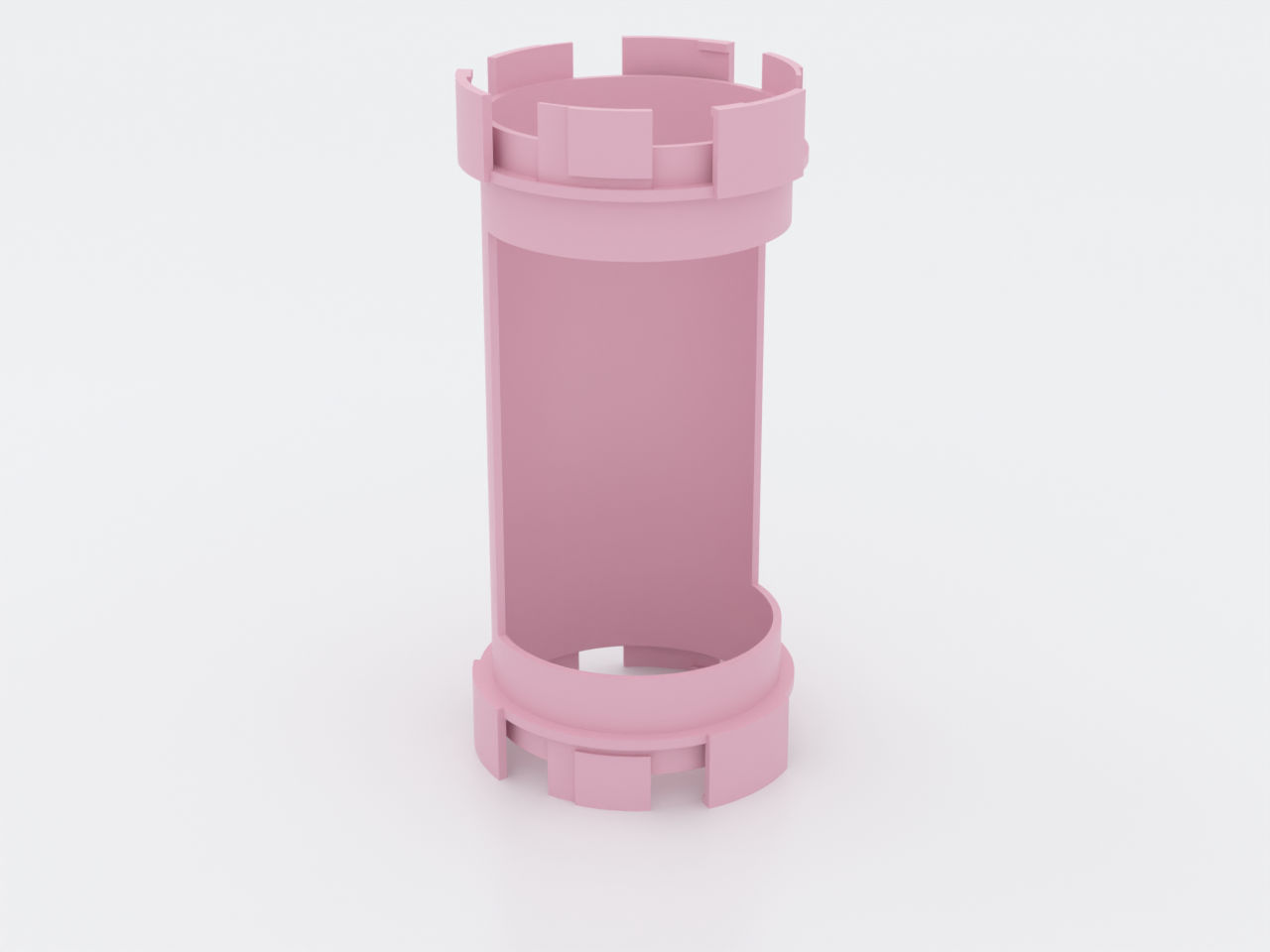
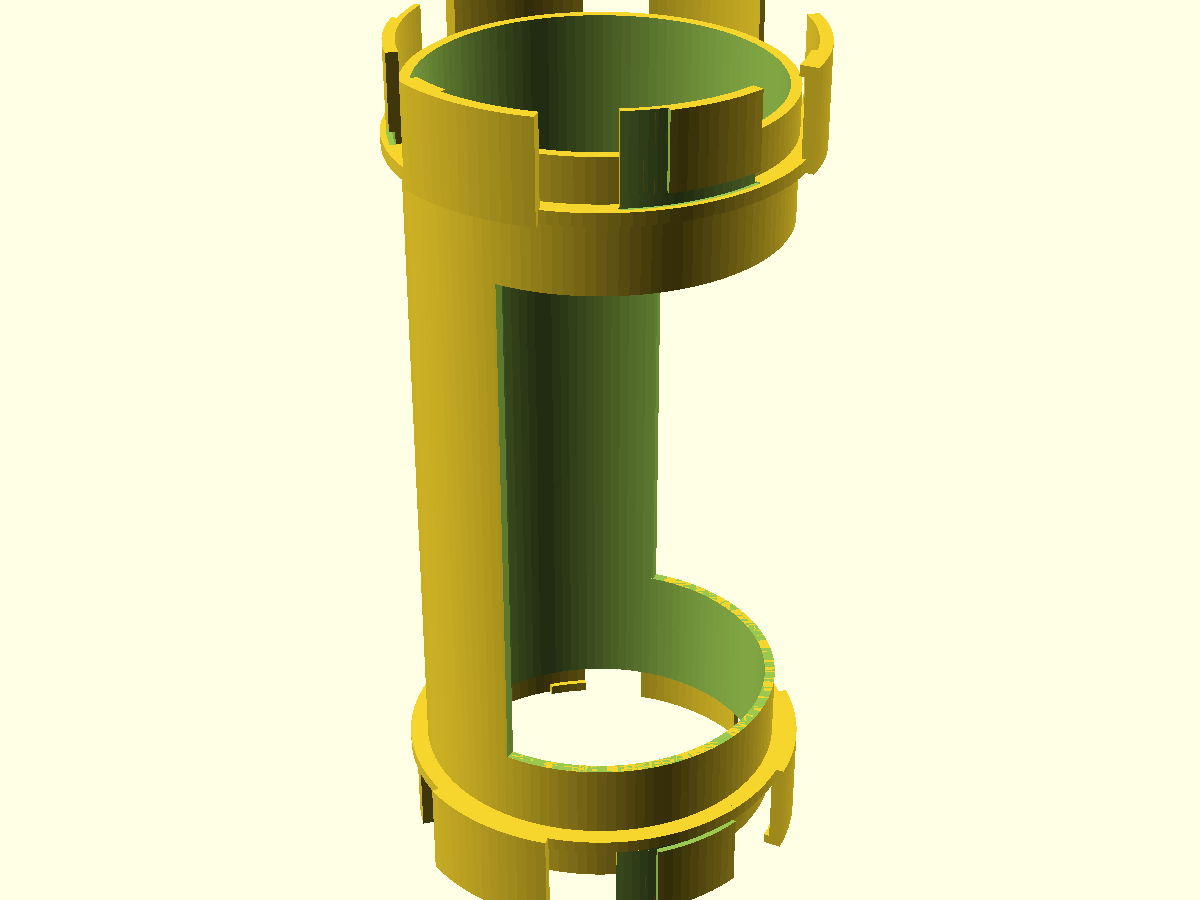
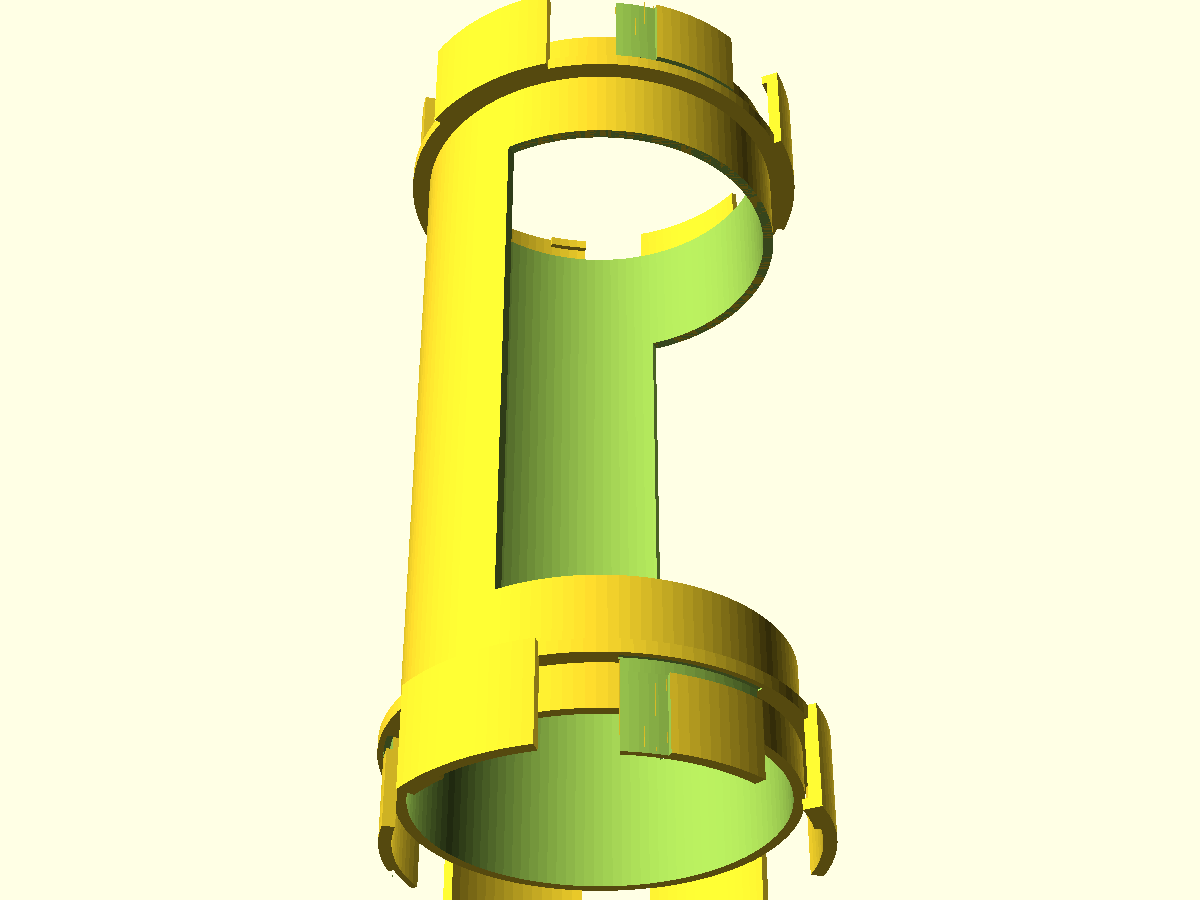
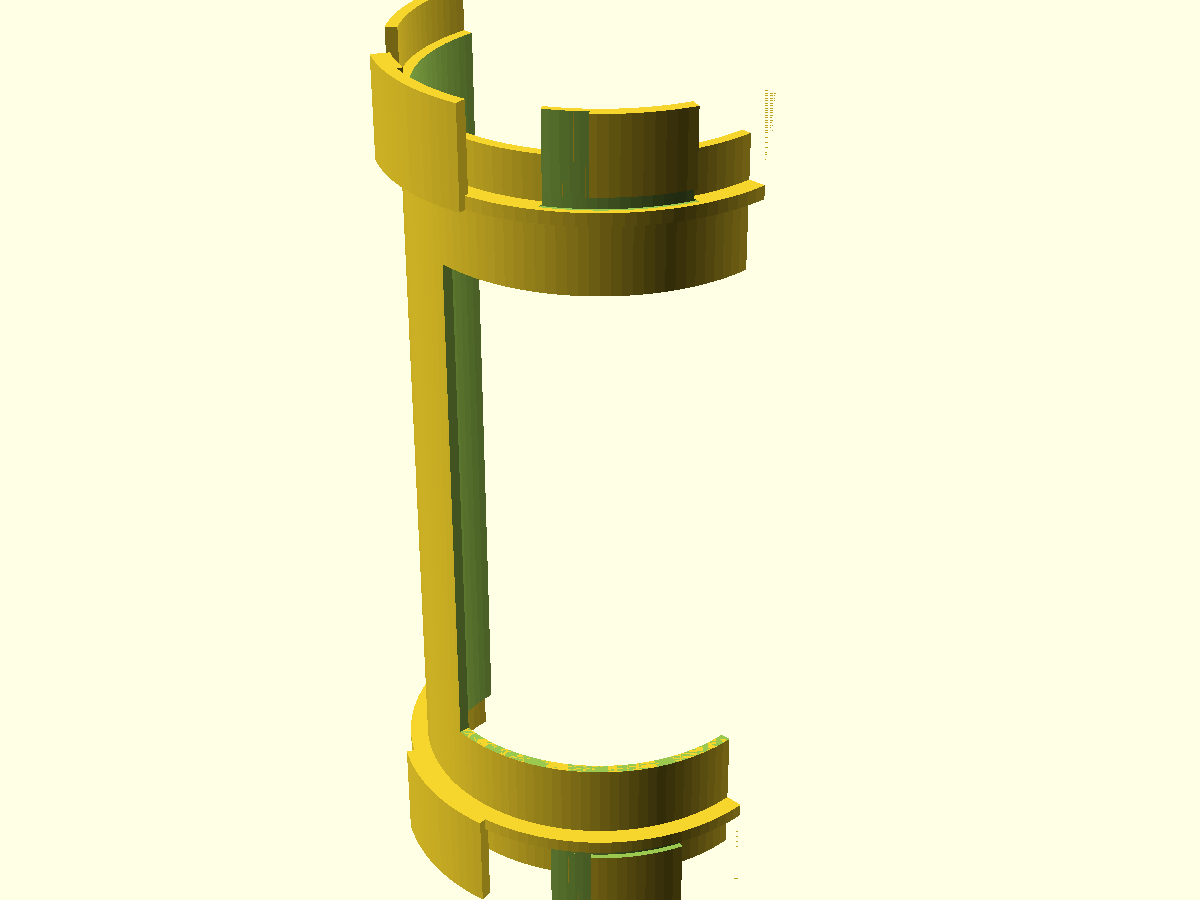
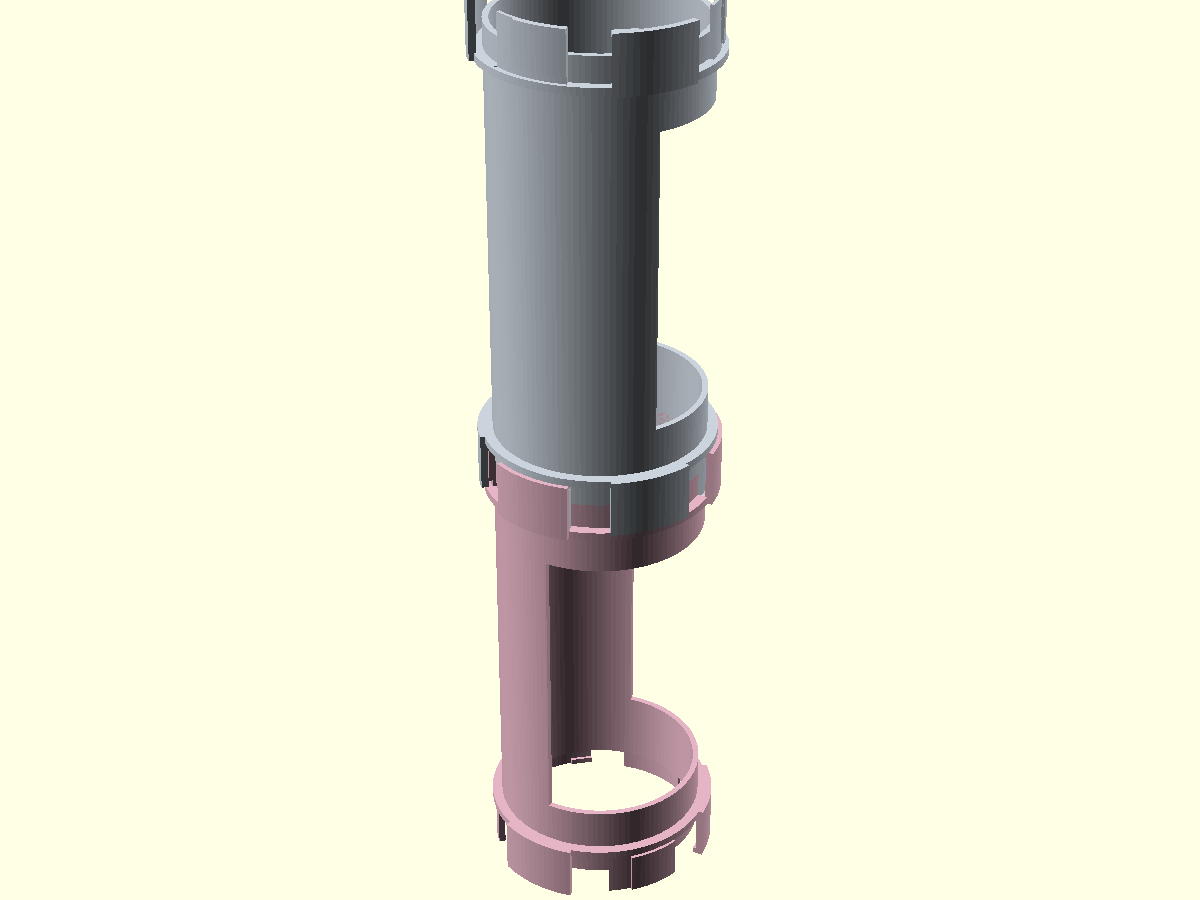
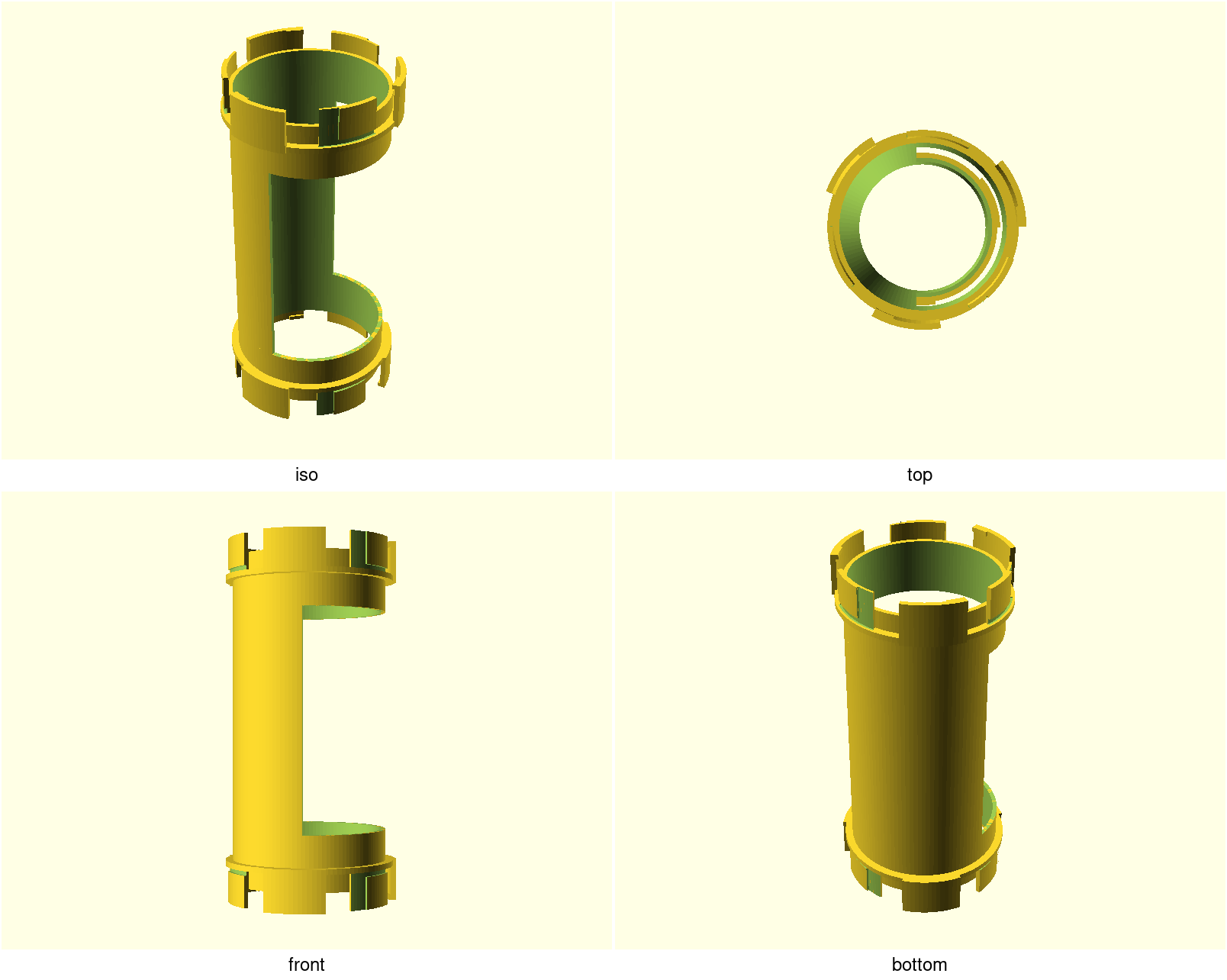
An 80 mm-bore straight with a longitudinal window cut through the middle span — the part that resets a run. Under the NUGGS length rule no continuously-enclosed run may exceed 2 × your animal's body length, and an open module — a window of at least 180° whose floor is still the bore's own arc — is one of the only three things that break a run (an open end, an open module, a turnaround node). Drop this into a run anywhere you want to see and reach the animal without disconnecting anything, or to split a long bridge into legal runs. For the NUGGS owner extending past one straight, this is the part that makes it possible.
What you get
open— the windowed module, ⌀96.8 × 200 mm overall at defaults (a 180 mm face-to-face body, coupling sectors projecting 10 mm past each face)coupon— one port stub (nuggs-open-coupon.scad); print two and mate them to tune the coupling fit before committing to the big print
The pair and cutaway renders above are review previews, not printable
parts — each module prints alone, standing on its port.
Print settings
- Material: PETG (the family default — its stiffness holds the window's rim walls) or PLA. Natural/uncoloured if the run lives between enclosures.
- Layer height: 0.2 mm
- Perimeters: 5 (fills the 2.4 mm wall)
- Infill: 20 %
- Supports: none needed — every downward-facing surface is ≥ 50°
- Orientation: tube axis vertical, standing on the port's sector tips, exactly as it renders. This is the only self-supporting pose: the two window mouth planes print as flat 2.4 mm bridges and the rim walls stand vertical. The window's azimuth (which way it faces around the tube) is print-irrelevant — every layer is the same 170° annulus segment.
- Brim: recommended,
outer_and_inner, 5 mm — same reasoning as the straight: the part stands on three sector-tip pads, and a 200 mm tall part on that footprint wants the extra anchored area. It does not bridge between the pads. - Bed fit: ⌀96.8 mm × 200 mm tall — fits a 256³ build volume.
Print the coupon first (see below) — the coupling fit is the one thing that changes per printer.
Parameters
| Parameter | Default | What it does |
|---|---|---|
bore_d | 80 mm | Internal bore. The headline number; asserted ≥ min_bore_mm |
open_deg | 190° | Window arc. ≥ 180° is what makes this a break in a run — lower and the module is a lie (a straight with a slot). 190 ships for shrink margin; raise toward 220 for easier hand access |
body_len | 180 mm | Face-to-face length, same as the straight's, so runs alternate predictably |
neck_len | 30 mm | Full-round shell kept at each end. Must stay ≥ the port zone (asserted); it is what the coupling's inner sectors fuse to |
min_bore_mm | 70 mm | Welfare floor (DTSchB pouch-full entrance minimum). Never lower it |
port_tol | 0.30 mm | The one fit knob. Uniform clearance on every coupling surface. Tune on the coupon in ±0.05 steps — the number you find applies to every NUGGS module |
wall | 2.4 mm | Tube shell and window rim; 6 perimeters at a 0.4 mm nozzle |
lug_deg | 40° | Coupling sector width — also the bed-contact width, since the part stands on these tips |
All parameters are at the top of nuggs-open.scad, grouped in Customizer
sections; override on the command line with -D 'open_deg=210'.
Assembly & use
Couple it like any NUGGS module: push onto the port, twist 14° to lock, either direction. The window does not couple to anything — it faces wherever you want it the moment you lock the joint.
One rule this part exists for: an open module resets the run budget
on both sides of it. A bridge of straight − open − straight is two runs, each
needing only its own half of the budget, where the same three modules with a
straight in the middle would be one illegal run. The length rule and what
counts as a break are on
nuggs's page.
To reach the animal: no disassembly needed — that is the point. The window's floor is the bore's own arc (there is no shelf to catch a paw anywhere along it), and at 190° the opening is the widest part of the void, so a loaded animal lifts straight out.
Print this first: nuggs-open-coupon.scad — one port stub. Mate two (or
one against any NUGGS module you already printed) and tune port_tol until
the quarter-turn seats without forcing, then print the module. The fit is
the shared standard, tuned once for every module.