
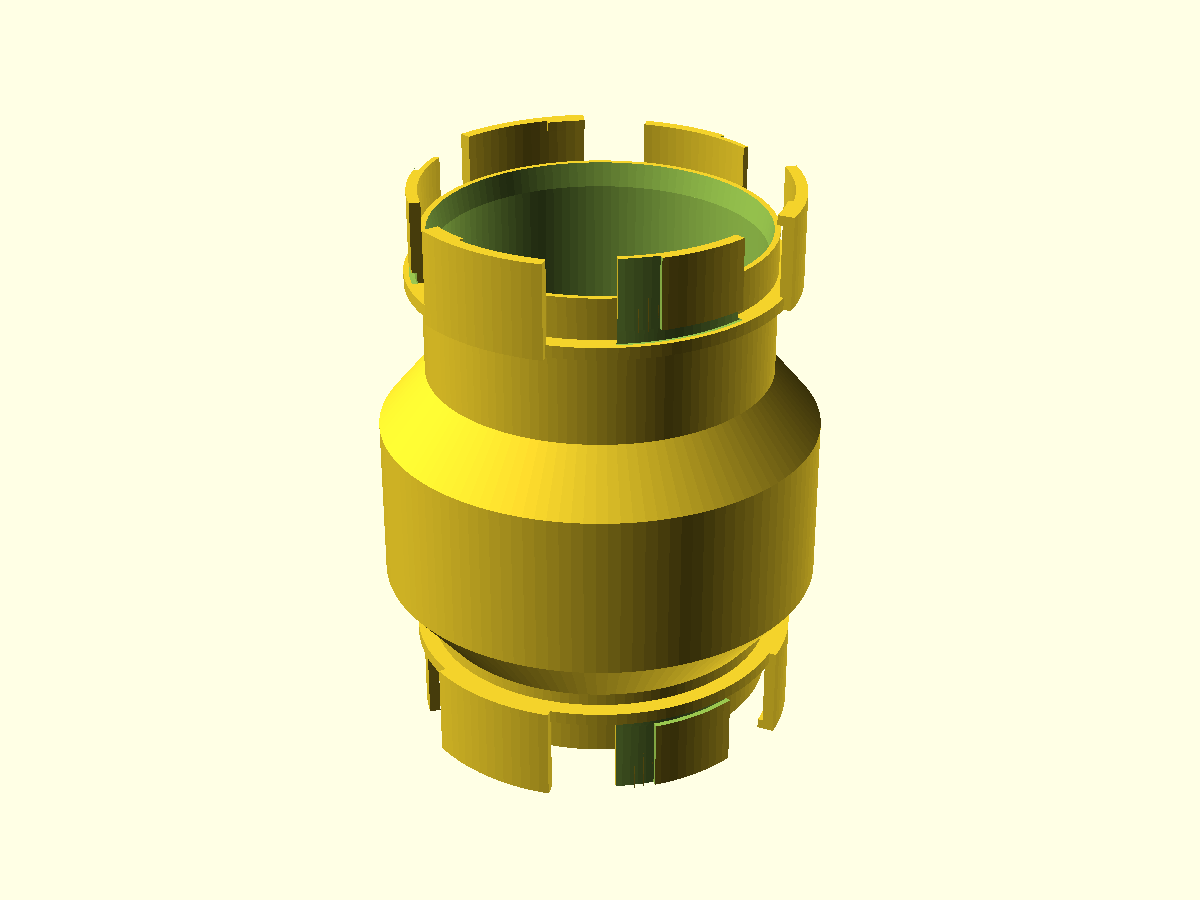
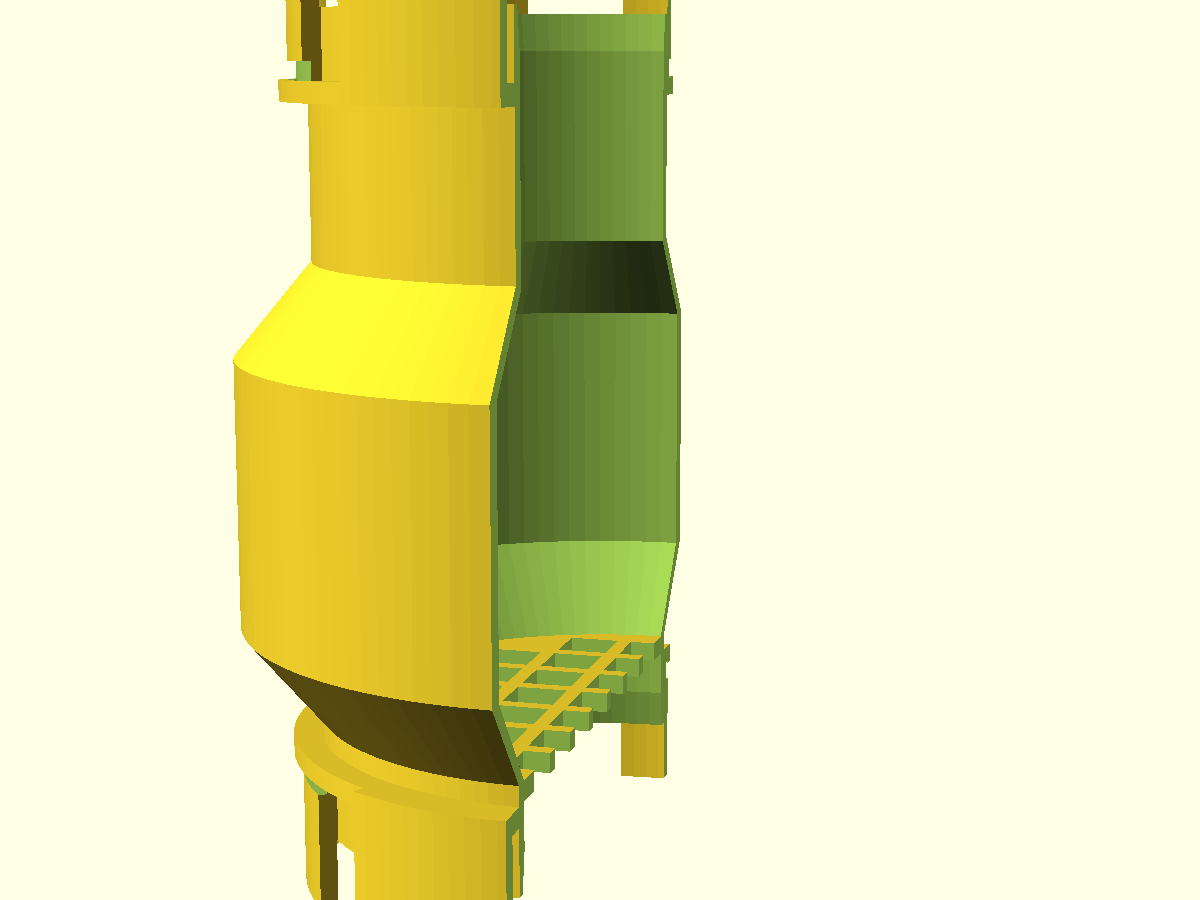
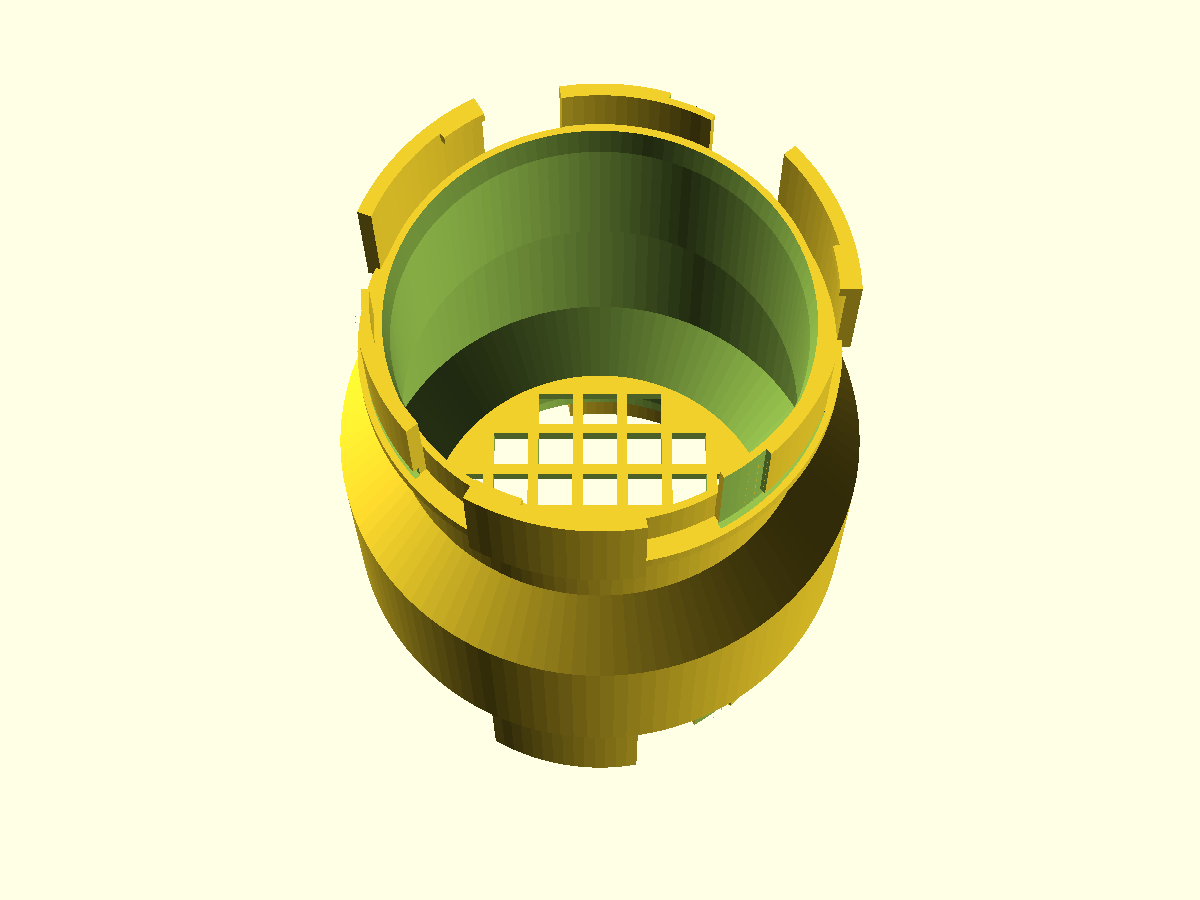
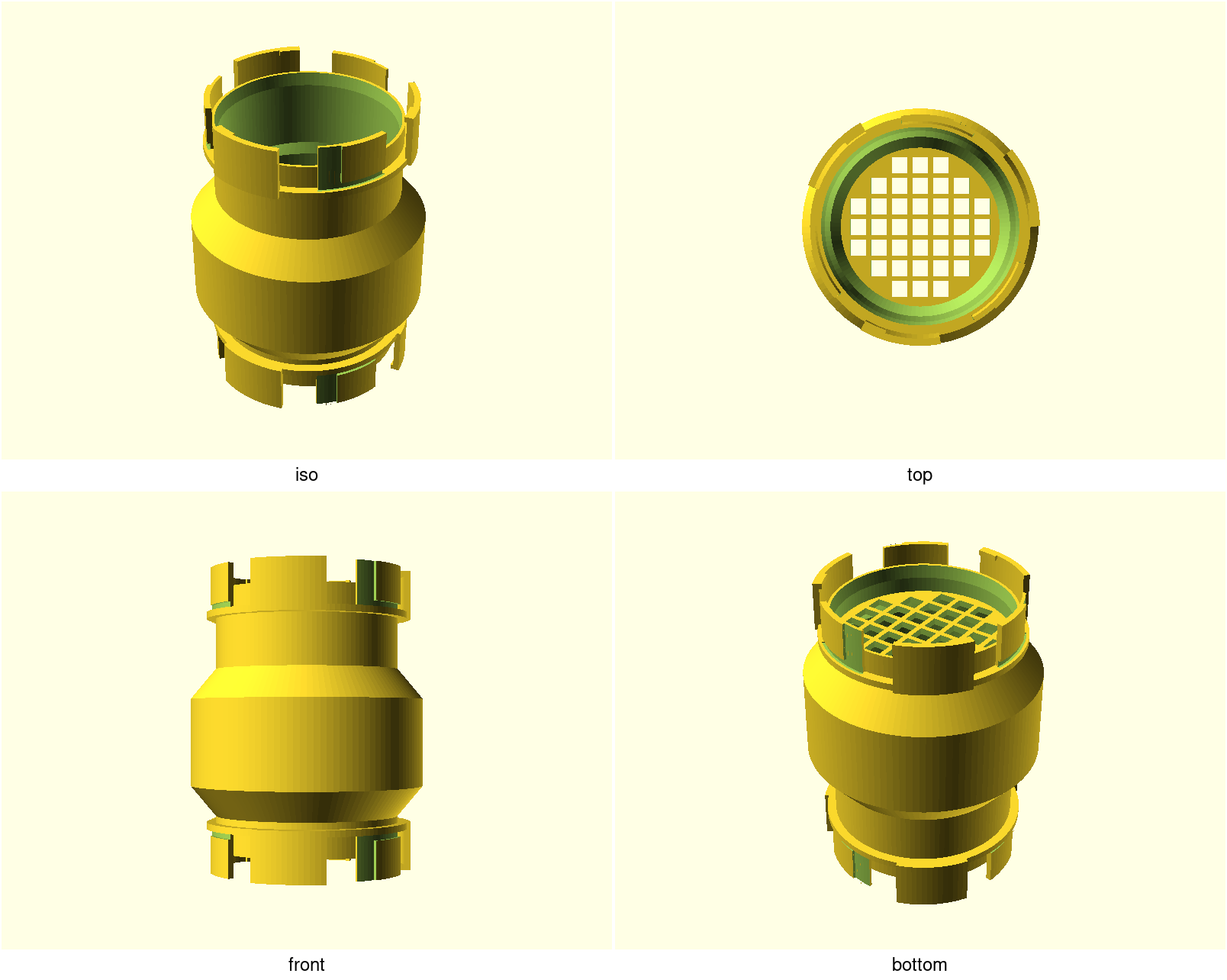
The gravity-fed top-fill food module for the N.U.G.G.S. hamster-tunnel system: a bulbous hopper that clicks onto any NUGGS face, holds a few days of pellets behind an 8 mm mesh floor, and lets them drop into the enclosure as they are eaten. The owner refills it from outside the cage, straight down through the open top port — no dismantling, no reaching in. Same genderless quarter-turn coupling every NUGGS module shares, so it threads onto a run, an elbow, or a cage-wall stub either way round.
Work in progress — nothing in this system has been printed yet. The hopper passes
gate.sh --sliceand is watertight in geometry, butport_tol = 0.30is an untested guess inherited from the shared standard. Print the coupon first (see Assembly & use) and expect to tune it.
What you get
One printed part: the hopper, with a NUGGS port at each end and the mesh floor built in — no separate steel mesh, no parts to lose.
hopper— the module (≈ 108 × 108 × 140 mm at defaults, printed standing on its bottom coupling sectors). Bore 80 mm top and bottom, bulb 102 mm clear inside, 37-cell mesh floor at the bulb's base.coupon— the print-this-first port stub (≈ 95 × 95 × 31 mm) you tune the quarter-turn fit on before committing to the full print.
How it feeds
- Gravity is the only mechanism. Pellets sit on the mesh floor; the ones over an open cell fall through into the enclosure below. As they are eaten, the next ones settle. No metering, no anti-hoarding auger — deliberately: the brief scoped those out, and a mechanism that can jam is worse than a mesh that can't.
- The 8 mm cell is the barrier. Small enough to stop a head or a stuffed
cheek pouch, wide enough to pass a standard pellet. It is a welfare-capped
parameter:
mesh_openmay be tuned for your pellet size but never past 12 mm. - Refill from outside. The top port is the fill mouth. Pour pellets in through it; the flared mouth funnels them home. Twist the hopper off for a full wash instead.
Print settings
- Material: PLA or PETG. PETG edges out PLA for anything food-adjacent (less brittle, survives washing); either prints the part as modelled.
- Layer height: 0.2 mm.
- Infill: 15–20 %; the shell and mesh ribs do the work.
- Supports: none needed. The bulb's shoulders sit at ~40° from vertical, the mesh floor's cells are 8 mm across (the slicer bridges them on layer 1), and the coupling sectors print on their tips by design.
- Orientation: as modelled — bottom port's sectors down on the bed, bore straight up, fill port printed last. Do not rotate it; the coupling is meant to print standing on its lug tips.
- Brim: yes. The part stands on three small sector tips (~530 mm² contact) and is tall — the same first layer every NUGGS module prints on.
- Heads up: it is a substantial part — ~153 g and ~12 h at defaults.
Shrink
bulb_rorbody_lenif you want it smaller.
Parameters
The handful most worth tuning; the rest are grouped in the Customizer sections
at the top of nuggs-hopper.scad.
| Parameter | Default | What it does |
|---|---|---|
bore_d | 80 mm | Internal bore — the shared NUGGS headline number. Floored at 70 mm by the coupling library (Syrian entrance minimum). |
port_tol | 0.30 mm | The one fit knob for the quarter-turn joint. Tune on the coupon in ±0.05 steps. |
mesh_open | 8 mm | Mesh cell width — the pellet-passes / head-stops barrier. Tunable for your pellet, never past 12 mm (welfare bound). |
mesh_rib_w | 2.4 mm | Rib width between cells. Keep ≥ 1.2 mm (gnaw floor). |
body_len | 120 mm | Port-face-to-port-face span. More = more capacity, taller print. |
bulb_r | 54 mm | Half the bulb OD (108 mm at defaults). Bigger = more capacity. |
eq_h | 40 mm | Height of the bulb's straight equator band — the pellet column sits here. |
shoulder | 1.2 | Bulb taper rate; 1.2 ≈ 40° from vertical, self-supporting. Do not go below 1.0 (45° ceiling). |
Override on the command line, e.g. -D 'mesh_open=9' or -D 'bulb_r=50'.
Assembly & use
- Print the coupon first.
nuggs-hopper-coupon.scadis a bore-clean port stub. Mate two of them (or one to any NUGGS module) and stepport_tolin ±0.05 until the quarter-turn seats snugly without forcing. Set that value innuggs-hopper.scadbefore printing the hopper. - Print the hopper with a brim, no supports, bottom-port down.
- Fit it onto any NUGGS face pointing up or sideways: push together, twist a quarter turn either way. For a cage-wall mount, pair it with a cage-wall stub so the hopper stands outside, ports vertical.
- Fill it through the top port: a handful of pellets, and gravity does the rest. Wash by twisting off and rinsing — the mesh floor is monolithic, so there is nothing to disassemble and lose.