
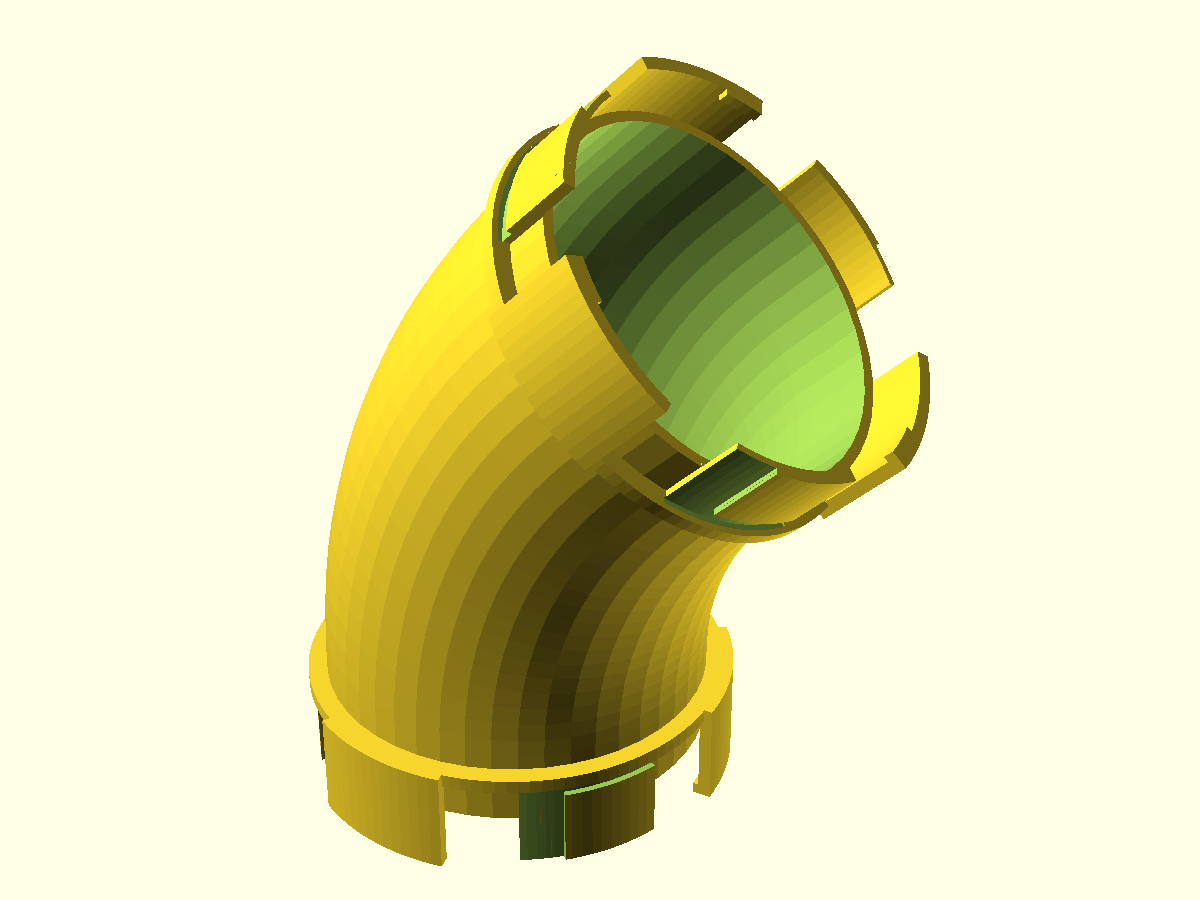
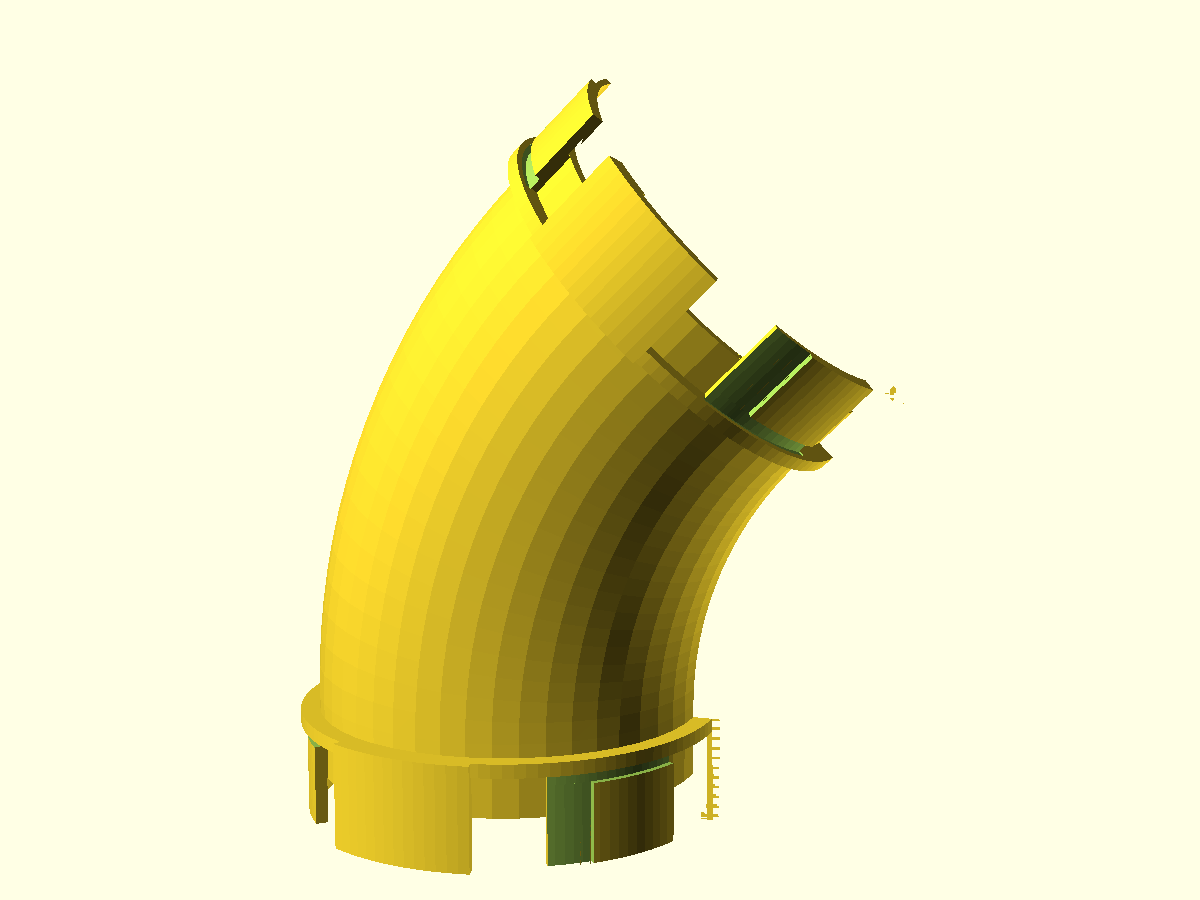
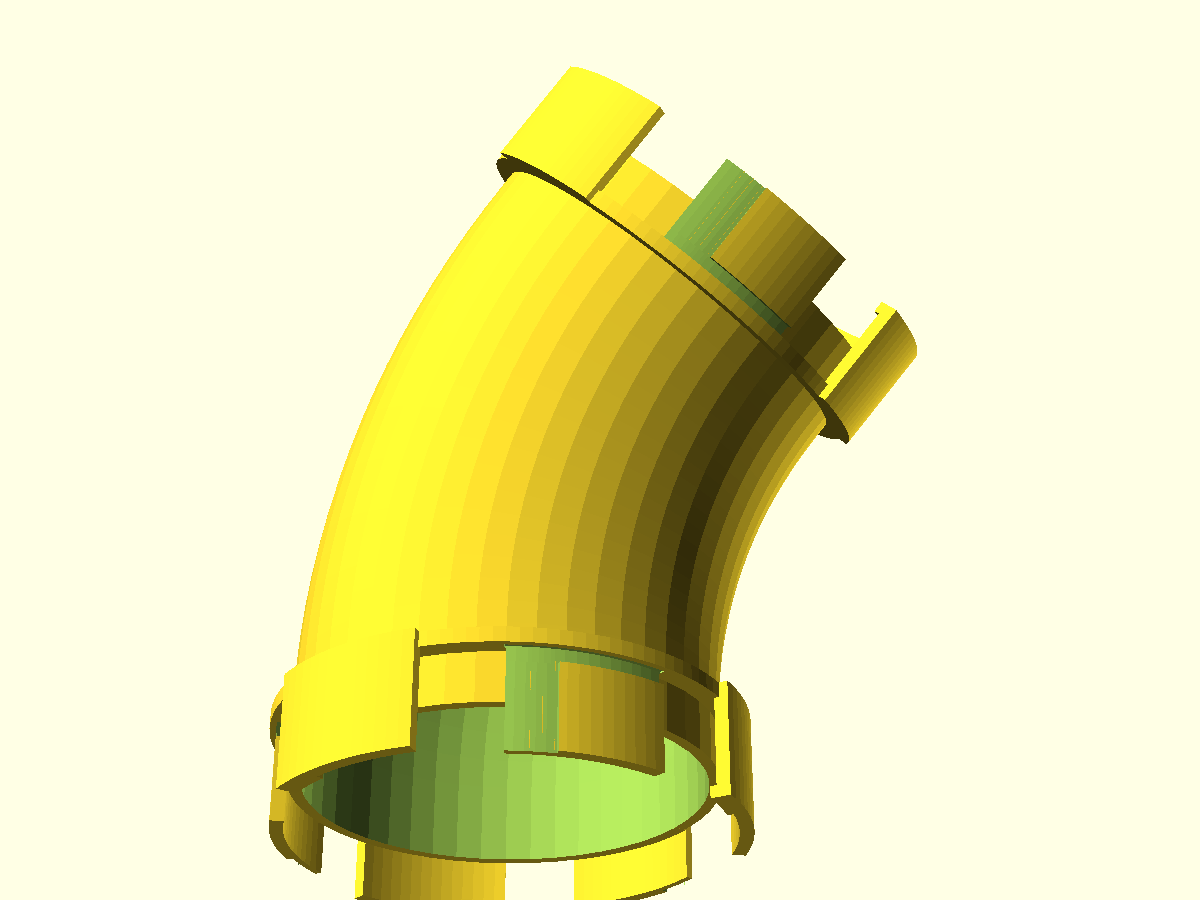
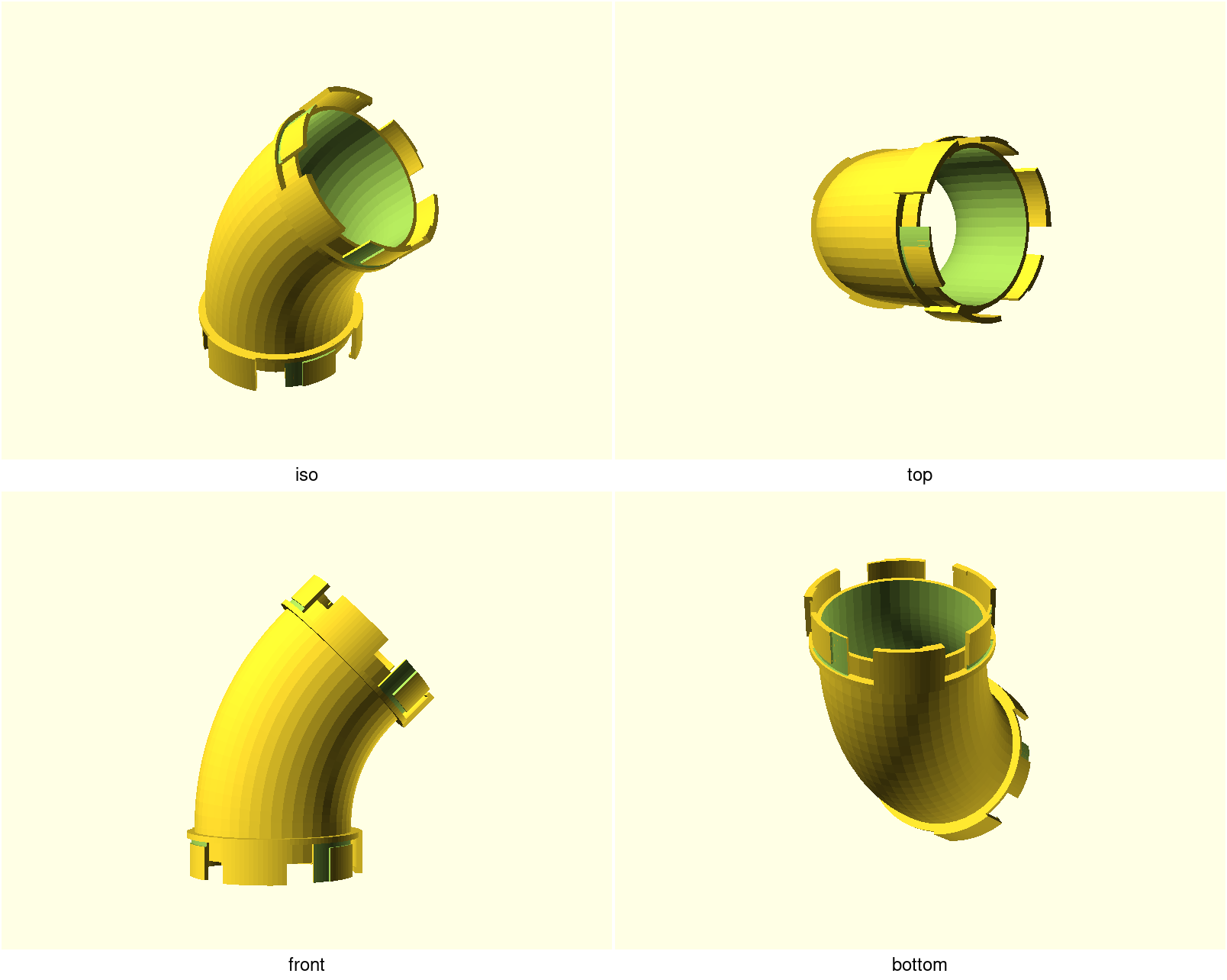
A curved N.U.G.G.S. module that routes an 80 mm-bore hamster tunnel run around a corner. It carries the genderless quarter-turn NUGGS port on each end, so it drops into any run between two other modules — a straight, a bulkhead, another elbow — and twists shut a quarter turn either way. The bore stays a continuous, smooth 80 mm circle through the bend: a NUGGS welfare non-negotiable, because a live animal travels this corner and any interior ledge or step is a hazard.
The default is a 45° elbow — the supportless, welfare-clean maximum for a vertically-printed enclosed bore (see Print settings). A full 90° corner is two of these coupled; because every NUGGS face mates with every other, a pair makes any 0–90° turn in any plane.
What you get
One printable part: a bent tube with a NUGGS port at each end, printed as a single piece.
elbow— the 45° elbow (approx. 134 × 95 × 161 mm envelope; ~126 g at the slicer defaults below). Inherits every coupling dimension from the NUGGS standard (lib/nuggs-coupling.scad): 80 mm bore, 84.8 mm tube OD, 96.8 mm coupling-ring OD.
The pair and cutaway views (-D part="pair", -D part="cutaway") are
review previews, not separate prints.
Print settings
The elbow is designed to print standing on its inlet flange, the same orientation as the NUGGS straight — the three coupling-sector tips are the bed contact.
- Material: PLA or PETG.
- Layer height: 0.2 mm.
- Infill: 15–20 % (walls carry the load; the tube is 2.4 mm / 6 perimeters).
- Supports: none for the default 45° bend. This is the whole reason the
default turn is 45°: a vertically-printed enclosed bore has a ~45° overhang
ceiling, so at 45° the bore ceiling holds itself up and no support ever lands
inside the bore (which the smooth-bore welfare rule forbids). Turning
bend_anglepast 45° needs support inside the bore — don't, unless you have a reason to accept it; couple two 45° elbows for a 90° corner instead. - Orientation: inlet flange down, bore vertical at the inlet. printcheck confirms this is as good as any axis-aligned alternative.
- Brim: recommended. The part stands on three sector tips, so the first-layer contact patch is small (~530 mm²); a brim keeps it planted.
At the committed quality the part scores 76/100 — printable with caveats in
printcheck (watertight, one body, no critical issues; the caveats are the 2 %
bend-belly overhang and the small bed-contact patch, both inherent and both
addressed above).
Parameters
All parameters are at the top of nuggs-elbow.scad, grouped in Customizer
sections; override on the command line with -D 'bend_angle=60'.
| Parameter | Default | What it does |
|---|---|---|
bend_angle | 45° | Turn angle of the elbow. 45° is the supportless maximum; up to 90° is allowed but needs bore support. |
bend_radius | 120 mm | Centerline radius of the bend (~1.5× bore). Gentler = shallower overhang; the bore stays a full circle regardless. |
port_stub | 16 mm | Straight full-round shell each port fuses to, past the coupling collar (also a short grip). |
bore_d | 80 mm | Internal bore, the headline number. A NUGGS-standard value; asserted ≥ 70 mm (welfare floor). |
wall | 2.4 mm | Tube shell thickness (6 perimeters at a 0.4 mm nozzle). |
port_tol | 0.30 mm | The coupling fit clearance — owned by the NUGGS standard, tuned on the nuggs coupon, not here. |
The coupling parameters (lug_r, port_proj, n_lug, lug_deg, twist_deg,
…) are the NUGGS standard defaults: change them and this elbow no longer mates
with other NUGGS modules. They are exposed for the Customizer, not for tuning.
Assembly & use
- Into a run: push a port onto any other NUGGS port and twist a quarter turn either way; the bayonet ribs seat. The joint is genderless, so orientation never has to be got right, and it is hand-releasable.
- A 90° corner: couple two elbows. The second one's clocking is free (the quarter-turn joint retains at any of its clockings), so rotate it to aim the outlet wherever the run needs to go.
- Welfare: this elbow is a bend, and per the NUGGS charter a bend is not
a break in an enclosed run — it does not reset the per-run length limit. Count
it as continuously enclosed bore when you plan a run length (see
designs/nuggsand its NOTES.md for the run-length rule and its source).