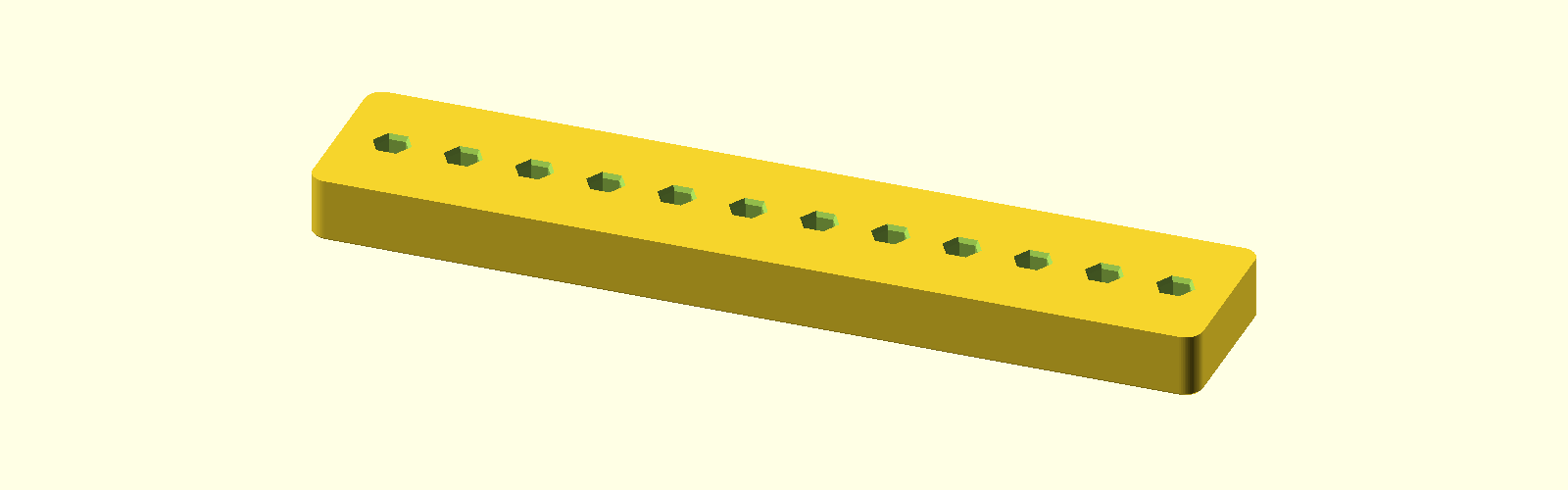
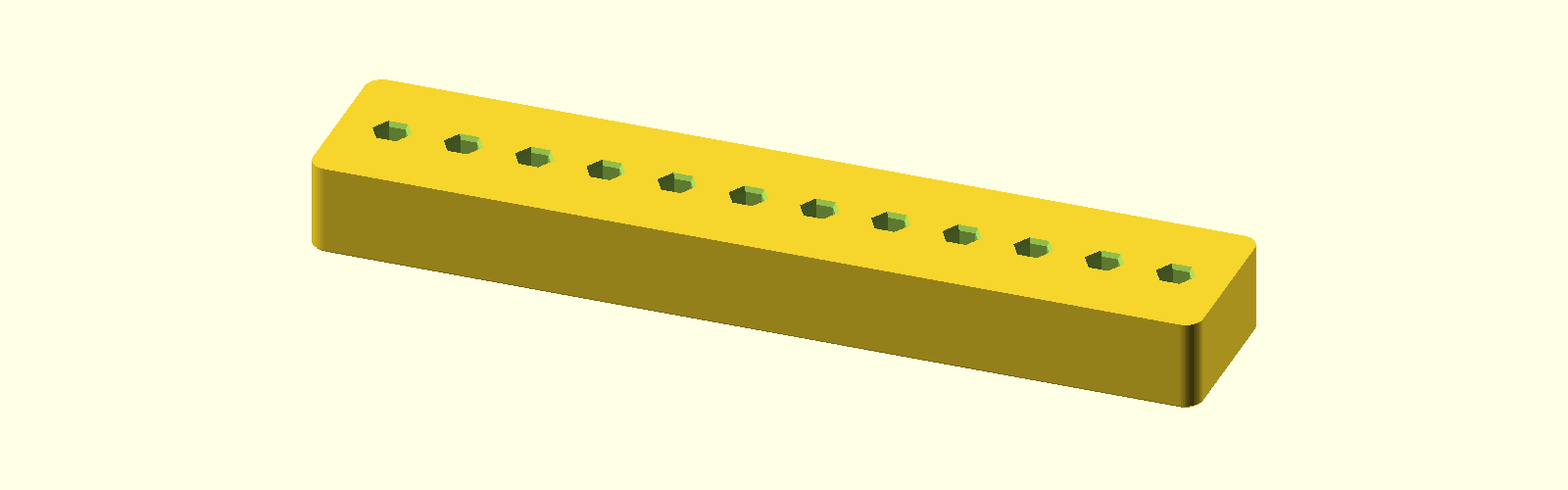
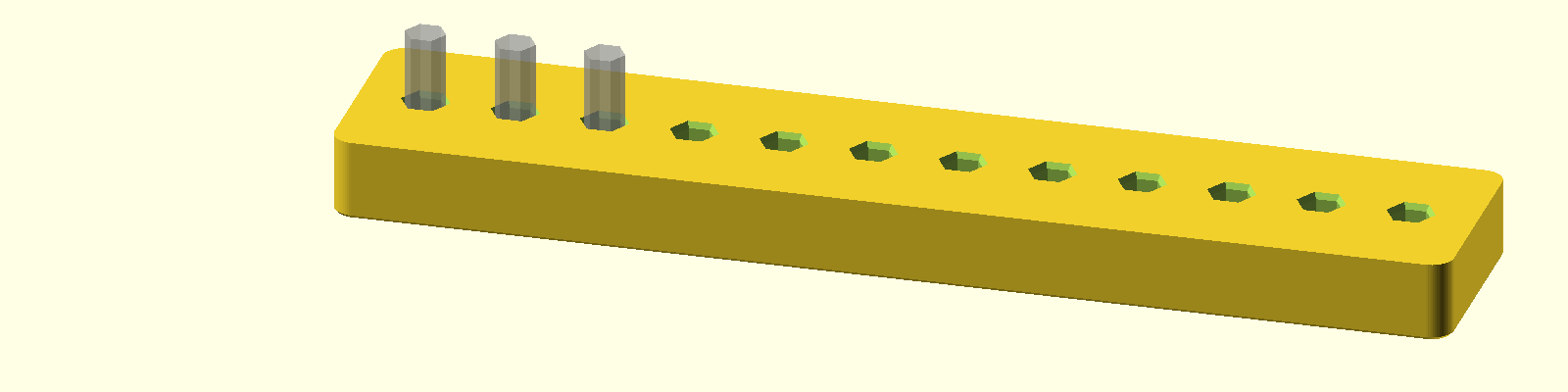

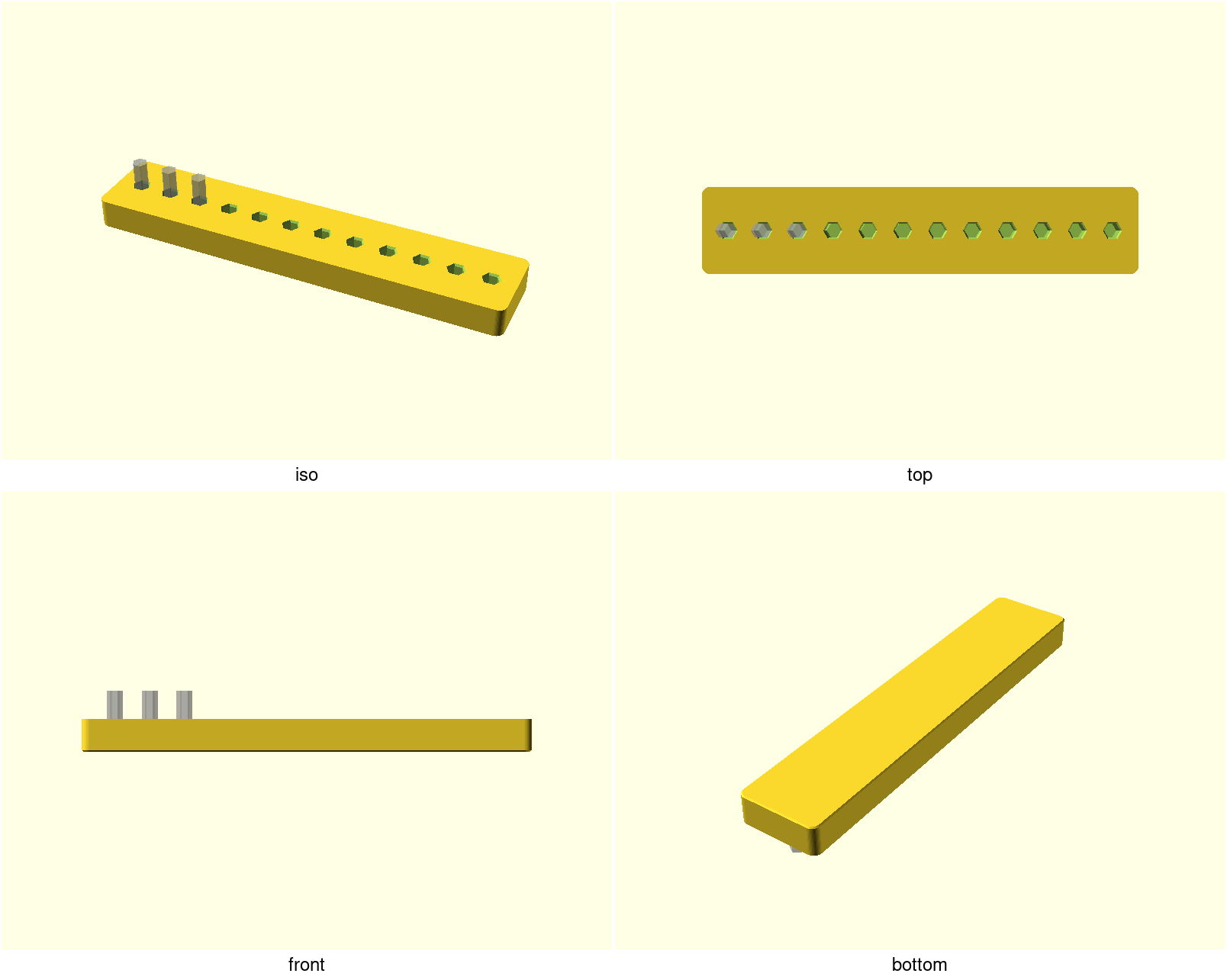
A bench-top rail that stores twelve ¼″ hex driver bits standing up, each held by a printed hex pocket and presented label-up — no more fishing through a drawer for the one bit you need. The engineering is the fit: the pocket's across-flats is a parameter, tuned on a small test coupon so the bits click in and still release one-handed on your printer, with your bits.
What you get
rail-short— twelve pockets for standard ¼″ bits (200 × 40 × 14.4 mm)rail-long— the same rail with an 18 mm socket for long (50/75 mm) bits (200 × 40 × 20.4 mm)hex-bit-rail-coupon— the print-this-first fit strip: six pockets sweeping across-flats at −0.15 / 0 / +0.15, values embossed beside each (152 × 18.4 × 14.4 mm)
The two rails print separately; the deliverable is the multi-object plate
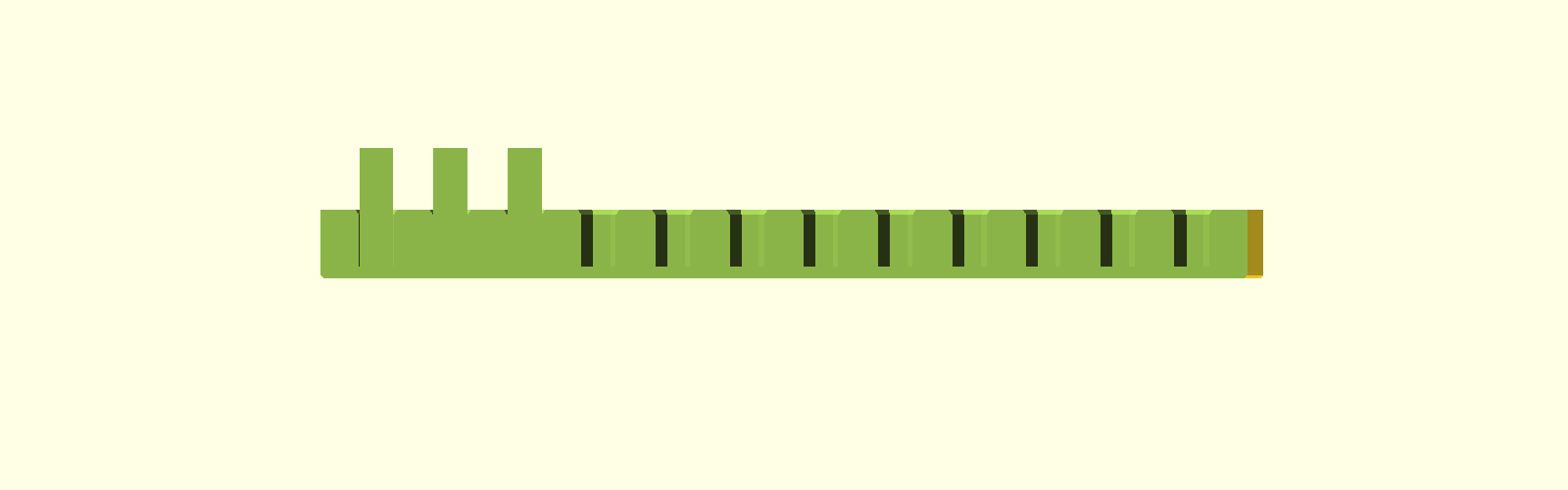
(build/hex-bit-rail-plate.3mf), never a merged STL. Bits stand ~13 mm
proud of the short rail — enough to grab with a fingertip.
Print settings
- Material: PLA (a stiff rail, not a flexing member); PETG if pockets wear loose
- Layer height: 0.2 mm — a 6.35 mm hex resolves cleanly
- Infill: 15 % grid; the walls carry the load
- Perimeters: 3
- Supports: none needed — pockets print open-top, exactly as drawn
- Orientation: flat on the bed, pockets up (as rendered)
- Print the coupon first (below), then the rails at the winning fit
Print this first: tune the fit
Printed hex holes come out undersize, and every printer disagrees by a couple of tenths. The coupon sweeps the fit so you don't gamble a two-hour rail print:
- Caliper two or three of your bits across the flats. Not ≈ 6.35 mm? Set
bit_afto your measurement first. - Print the coupon in the rail's material.
- Drop a bit in each pocket pair: you want the tightest pocket the bit still clicks into and pulls out one-handed without rocking.
- Print the rails at the winner:
-D 'hex_fit=<value>'(or edit the parameter). - Record the result in NOTES.md's field-test log so the next owner starts from your measurement.
Parameters
| Parameter | Default | What it does |
|---|---|---|
bit_af | 6.35 mm | your bits' hex across-flats — caliper before trusting the coupon |
hex_fit | 0.1 mm | clearance added to the pocket across-flats; the coupon's winner goes here |
pockets | 12 | pockets per rail |
pitch | 16 mm | pocket centre-to-centre spacing |
pocket_depth_short | 12 mm | short-rail pocket depth |
pocket_depth_long | 18 mm | long-rail socket depth |
rail_w | 40 mm | rail width |
mouth_break | 0.6 mm | 45° chamfer at each mouth — one-handed insertion |
All parameters are at the top of hex-bit-rail.scad, grouped in Customizer
sections; override on the command line with -D 'pockets=8'. Fit proofs and
the cutaway render are selected with part.
Use
Drop a bit into a pocket — the 45° mouth break forgives a slightly off-angle start — and it stands ~13 mm proud, label up, gripped on all six flats. Pull straight out one-handed; whether the rail tips under a firm extraction is untested in a field pull (stiffness is designed in, not yet measured). Print the long rail for 50/75 mm bits: same pockets, deeper socket.