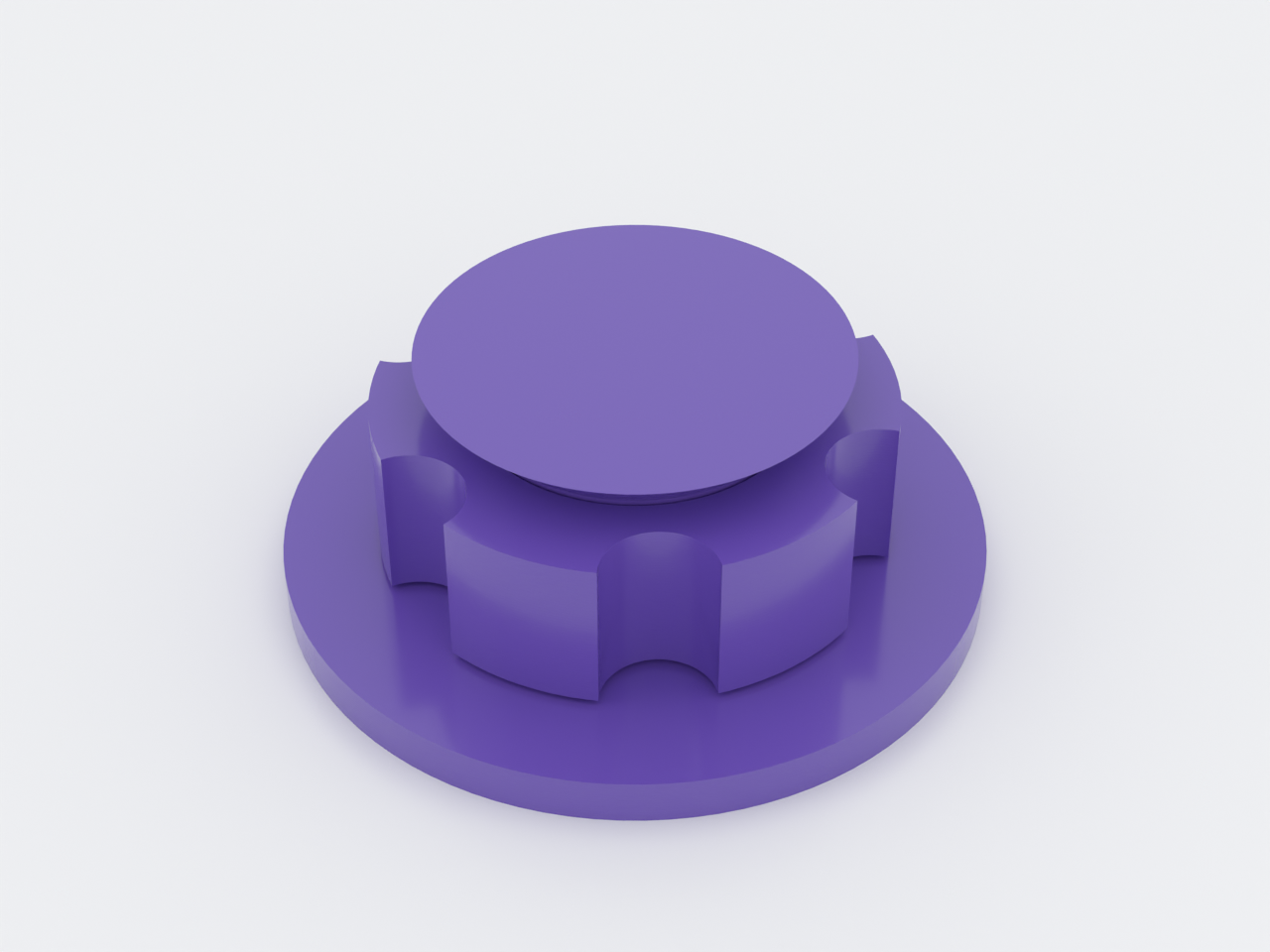
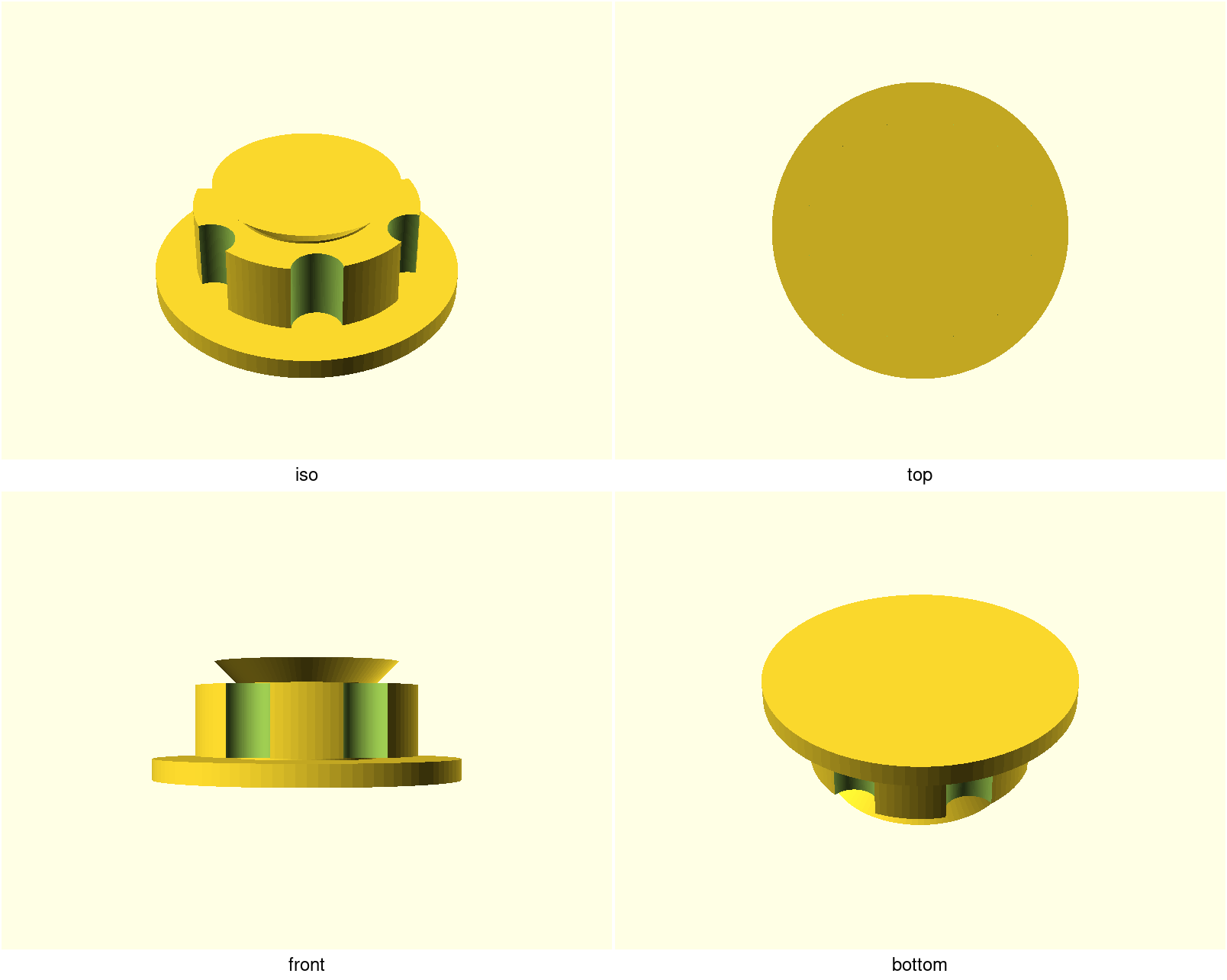
A one-piece fidget spinner that comes off the print bed already assembled and
spinning — no supports, no assembly. A rotor is captured on a fixed post under a
45° cone cap; the first spin shears the microscopic print-in-place fusion and
then it runs free. A worked example of print-in-place kinematics
(docs/advanced-techniques.md, Domain 3).
What you get
captive-spinner— one print, 44 mm across × 16.8 mm tall, made of two separate bodies (fixed base+post+cap, and the free rotor ring, OD 32 × 10 wide with six finger scallops).
Print settings
- Material: PLA is fine
- Layer height: 0.2 mm (the clearances are quantized to it — see below)
- Infill: 15–20 %
- Supports: none needed — the ring's underside bridges over the axial gap by design, and the cap's cone is a self-supporting 45° lip
- Orientation: as modelled (base on the bed, axis vertical)
- First use: give the rotor a firm first spin to break it free.
The two gaps are deliberately different numbers because different physics
govern them: the radial bore↔post gap is spread-limited so it's tight and
derived from your process constants (k_xy · line_w ≈ 0.21 with a 0.4 mm
nozzle), while the axial float below/above the rotor is sag-limited and snapped
to whole layers (z_layers · layer_h = 0.4). A single global tolerance is the
classic print-in-place bug.
Parameters
| Parameter | Default | What it does |
|---|---|---|
k_xy | 0.45 | radial clearance factor — the tuning knob for the rotor↔post fit |
z_layers | 2 | axial float in whole layers (sag-limited) |
nozzle_d | 0.4 mm | your nozzle — drives line_w and therefore xy_tol |
layer_h | 0.2 mm | drives the axial gap quantization |
rotor_or | 16 mm | rotor outer radius (ring OD 32) |
cap_lip | 3 mm | how far the cap overhangs the bore (capture) |
scallops | 6 | finger grip notches |
All parameters are at the top of captive-spinner.scad; override with
-D 'k_xy=0.5'. If the rotor won't free, print a copy with k_xy +0.05 —
start with the coupon (captive-spinner-coupon.scad) to tune fast.